English
 Español
 tiếng việt
 русский
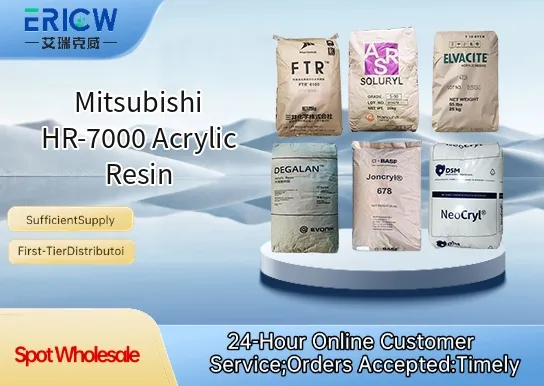
Exceptional UV resistance and long-term color stability for outdoor durability.
High transparency and excellent gloss retention in clear coating systems.
Good compatibility with common crosslinkers including melamine and polyisocyanates.
Low VOC formulation suitable for environmentally compliant industrial coatings.
Consistent batch-to-batch performance ensured by Mitsubishi’s proprietary polymerization control.
Automotive OEM topcoats and clearcoats.
Industrial maintenance coatings for metal and plastic substrates.
Architectural pre-coated metal (coil coating) finishes.
High-performance refinish coatings for automotive repair.
General-purpose solvent-based decorative coatings requiring clarity and weatherability.
| Chemical Type | Thermosetting acrylic copolymer |
| Product Form | Liquid resin solution |
| Appearance | Clear, pale yellow to colorless liquid |
| Solvent System | Toluene/xylene/ester blend (typical) |
| Non-Volatile Content (NV%) | 50–55% (by weight, 120°C, 60 min) |
| Acid Value | 8–12 mg KOH/g |
| Hydroxyl Value | 65–75 mg KOH/g |
| Viscosity (25°C) | 4,000–6,000 cP (Brookfield RVT, spindle #3, 20 rpm) |
Q1: What is the primary function of Mitsubishi HR-7000 in coating formulations?
A: HR-7000 is a high-molecular-weight acrylic resin designed primarily as a rheology modifier and film-forming aid. It enhances viscosity control, improves sag resistance in vertical applications, and contributes to uniform film formation without compromising clarity or gloss retention.
Q2: Is HR-7000 compatible with waterborne and solvent-based systems?
A: Yes, HR-7000 exhibits broad compatibility across both waterborne acrylic emulsions and common organic solvent systems, including esters, glycol ethers, and aromatic hydrocarbons. Its performance may vary depending on pH, ionic strength, and co-solvent selection—pre-testing in the final formulation is recommended.
Q3: How should HR-7000 be incorporated into a formulation to ensure optimal dispersion?
A: For best results, HR-7000 should be added during the let-down stage under moderate agitation. Pre-dilution with a portion of the carrier solvent or water (depending on system type) helps prevent agglomeration. Avoid high-shear mixing at initial addition to minimize mechanical degradation of the polymer chains.
Q4: Does HR-7000 contribute to UV stability in finished coatings?
A: As a non-yellowing acrylic polymer, HR-7000 inherently supports good UV resistance in clear and pigmented systems. While it is not a UV absorber or HALS additive itself, its chemical structure resists photo-oxidative degradation, helping maintain long-term clarity and color stability under ambient exposure conditions.
Q5: Can HR-7000 be used in low-VOC or high-solids coating applications?
A: Yes, HR-7000 is well-suited for low-VOC and high-solids formulations due to its high solids content and efficient thickening efficiency at relatively low dosages. It enables formulators to reduce solvent demand while maintaining application performance and film integrity.
Contact With Us:
E-mail: wangxingqiang@ericwchem.com
Have a Questions? Call Us:
Add:
Building A1, Jiete Industrial Park, Huangpu District, Guangzhou City, Guangdong Province, China