English
 Español
 tiếng việt
 русский
High thermal stability with continuous service capability up to 200 °C.
Excellent electrical insulation properties across wide temperature and frequency ranges.
Good compatibility with organic resins, facilitating hybrid formulation development.
Low volatility and minimal outgassing, suitable for vacuum and aerospace-critical environments.
Forms hard, glossy, abrasion-resistant films upon solvent evaporation and thermal cure.
High-temperature wire and cable insulation coatings.
Electrical encapsulants and potting compounds for power electronics.
Release coatings for composite tooling and molding surfaces.
Binders in high-performance ceramic and refractory coatings.
Surface treatment agents for enhancing hydrophobicity and dielectric performance of substrates.
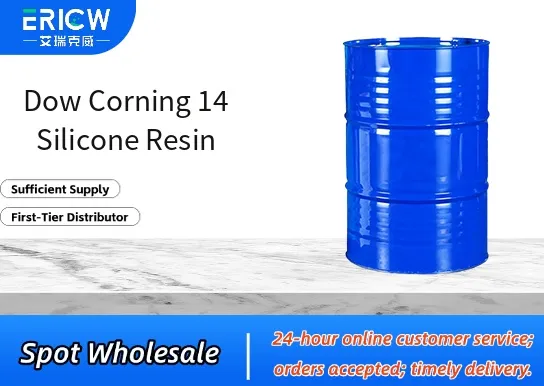
| Chemical Type | Methyl-phenyl silicone resin |
| Product Form | Solution in toluene |
| Appearance | Clear, colorless to pale yellow liquid |
| Non-Volatile Content (wt%) | 50 ± 2% |
| Viscosity (mPa·s, 25 °C) | 80–120 |
| Specific Gravity (25 °C) | 0.89–0.91 |
| Flash Point (°C, closed cup) | 4 °C |
| Primary Applications | High-temp coatings, electrical insulation, binder systems |
Q1: What is the primary function of Dow Corning® 14 Silicone Resin in coating and ink formulations?
A: Dow Corning® 14 is a methyl-phenyl silicone resin supplied as a solution in aromatic hydrocarbons. It is primarily used as a surface modifier to enhance mar resistance, slip, and substrate wetting—especially in high-performance industrial coatings, gravure and flexographic inks, and overprint varnishes.
Q2: Is Dow Corning® 14 compatible with common organic resin systems?
A: Yes, it demonstrates good compatibility with many thermoplastic and thermosetting resins including acrylics, alkyds, polyesters, and nitrocellulose. Compatibility should be confirmed experimentally for each specific formulation due to variations in solvent blends and molecular weight distributions.
Q3: How does Dow Corning® 14 affect film formation and gloss in cured coatings?
A: When properly incorporated, it generally supports uniform film formation without disrupting clarity or gloss. Its low surface energy promotes leveling and can help maintain or slightly enhance gloss, depending on concentration and cure conditions. Over-addition may lead to surface defects or reduced intercoat adhesion.
Q4: What are recommended handling and storage conditions for this product?
A: Store in tightly sealed original containers at temperatures between 15°C and 30°C, away from direct sunlight and strong oxidizers. Avoid prolonged exposure to moisture or freezing conditions. Ensure adequate ventilation during handling, as the carrier solvent is flammable and volatile.
Contact With Us:
E-mail: wangxingqiang@ericwchem.com
Have a Questions? Call Us:
Add:
Building A1, Jiete Industrial Park, Huangpu District, Guangzhou City, Guangdong Province, China