English
 Español
 tiếng việt
 русский
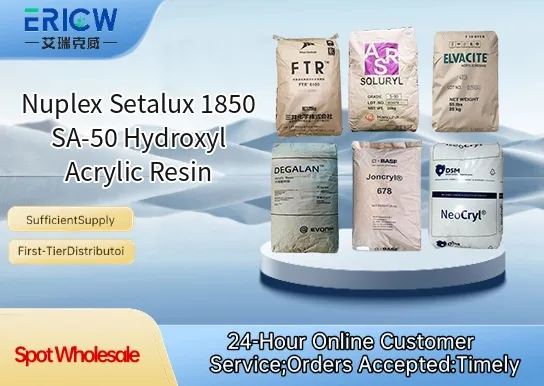
High hydroxyl functionality for excellent crosslinking with melamine and polyisocyanate curing agents.
Optimized molecular weight distribution for balanced flow, leveling, and film hardness development.
Low volatile organic compound (VOC) content, supporting compliant solventborne industrial coating formulations.
Superior UV stability and gloss retention in exterior-facing topcoats.
Good compatibility with common acrylic, polyester, and cellulose ester resins in multi-resin systems.
Automotive OEM and refinish basecoat/clearcoat systems.
Industrial maintenance coatings for metal substrates.
General-purpose coil coating primers and topcoats.
High-performance appliance finishes requiring durability and aesthetics.
Architectural metal cladding and curtain wall coatings.
| Chemical Type | Hydroxyl-functional acrylic copolymer |
| Product Form | Liquid resin solution |
| Appearance | Clear, pale yellow to amber liquid |
| Solvent System | Aromatic hydrocarbons (e.g., xylene, Solvesso™ 100) |
| Non-Volatile Content (wt%) | 50 ± 2% |
| Hydroxyl Value (mg KOH/g) | 85–95 |
| Acid Value (mg KOH/g) | < 5 |
| Viscosity (DIN 4, 23°C) | 120–160 mPa·s |
Q1: What is the primary function of Setalux 1850 SA-50 in coating formulations?
A: Setalux 1850 SA-50 is a hydroxyl-functional acrylic resin designed primarily as a reactive binder in two-component polyurethane and polyester-based coatings. It contributes to film formation, hardness development, chemical resistance, and long-term durability when crosslinked with isocyanate curing agents.
Q2: Is Setalux 1850 SA-50 compatible with common isocyanate hardeners?
A: Yes — it is formulated for compatibility with standard aliphatic and aromatic polyisocyanate hardeners, including HDI trimer and IPDI-based crosslinkers. Optimal performance is achieved when used with low-viscosity, non-yellowing hardeners in high-performance industrial and automotive topcoats.
Q3: How does Setalux 1850 SA-50 support VOC reduction in coatings?
A: This resin offers relatively low inherent viscosity and high solids content, enabling formulators to achieve target application viscosities with reduced solvent demand. It supports compliant high-solids and solvent-borne systems targeting lower VOC emissions without compromising flow, leveling, or cure response.
Q4: Can Setalux 1850 SA-50 be used in both ambient and forced-dry cure conditions?
A: Yes — it performs effectively under ambient cure conditions when paired with catalyzed isocyanate systems, and also delivers rapid through-cure and enhanced early hardness development in forced-dry (e.g., 60–80 °C) applications typical of industrial coil and automotive refinishing lines.
Contact With Us:
E-mail: wangxingqiang@ericwchem.com
Have a Questions? Call Us:
Add:
Building A1, Jiete Industrial Park, Huangpu District, Guangzhou City, Guangdong Province, China