English
 Español
 tiếng việt
 русский
High hydrolytic stability due to sterically hindered isocyanate groups.
Low volatility and reduced vapor pressure compared to aliphatic alternatives like HDI trimer.
Excellent UV resistance and color retention in demanding outdoor coatings.
Enables formulation of high-performance, solvent-free or low-VOC polyurethane systems.
Consistent reactivity profile supporting predictable gel times and pot life control.
Aerospace-grade topcoats and primers requiring long-term gloss and weatherability.
Automotive clearcoats and OEM refinish systems demanding exceptional clarity and durability.
High-end industrial maintenance coatings for offshore, wind turbine, and infrastructure assets.
Optical-grade adhesives and encapsulants where yellowing resistance is critical.
Advanced 3D printing resins requiring precise cure kinetics and thermal stability.
| Chemical Type | Aliphatic diisocyanate (Isophorone diisocyanate-based oligomer) |
| Product Form | Liquid |
| Appearance | Colorless to pale yellow transparent liquid |
| NCO Content (wt %) | 17.5–18.5% |
| Viscosity at 25°C (mPa·s) | 800–1,200 |
| Density at 20°C (g/cm³) | 1.14–1.18 |
| Flash Point (°C, closed cup) | 165–175 |
| Storage Stability | ≥12 months at <25°C in sealed, dry conditions |
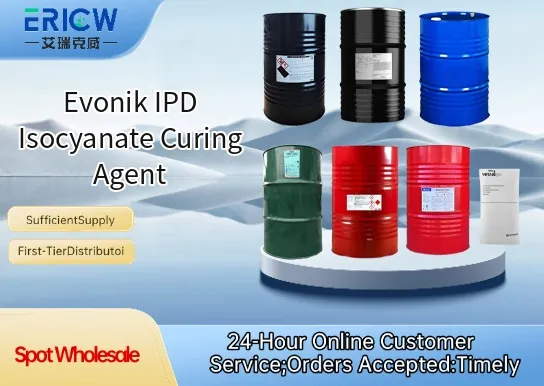
Q1: What is the primary function of Evonik IPD Isocyanate Curing Agent in coating and adhesive formulations?
A: It serves as a high-performance aliphatic curing agent that reacts with hydroxyl-terminated resins—such as polyols or acrylic polyols—to form durable, chemically resistant, and UV-stable polyurethane networks. Its IPD (isophorone diisocyanate) backbone contributes to excellent weatherability and low yellowing.
Q2: How does this curing agent compare to aromatic isocyanates like TDI or MDI in terms of performance and handling?
A: Unlike aromatic isocyanates, Evonik IPD-based curing agents offer superior light stability and non-yellowing characteristics, making them suitable for exterior and clear-coat applications. They also exhibit lower volatility and reduced skin sensitization potential compared to many conventional aliphatic alternatives, supporting safer industrial handling.
Q3: What are typical formulation considerations when using this curing agent?
A: Formulators should account for its moderate reactivity—slower than HDI trimer but faster than some other IPD derivatives—allowing for extended pot life while maintaining reasonable cure speed at ambient or elevated temperatures. Compatibility with common solvents and polyol types is generally good, though pre-testing is recommended for high-solids or waterborne systems.
Q4: Is this product supplied as a monomer, prepolymer, or modified oligomer?
A: Evonik IPD Isocyanate Curing Agent is typically supplied as a bi-functional, low-viscosity modified oligomer—often based on IPD monomer reacted with polyether or polyester polyols—to balance reactivity, viscosity, and NCO content without requiring additional blocking agents.
Q5: Can it be used in food-contact or pharmaceutical-grade coatings?
A: While the chemistry supports high-purity, low-volatility formulations suitable for demanding end uses, suitability for food-contact or pharmaceutical applications depends on full system validation—including final cured film testing and regulatory review by the formulator. Evonik provides technical documentation to support such evaluations upon request.
Contact With Us:
E-mail: wangxingqiang@ericwchem.com
Have a Questions? Call Us:
Add:
Building A1, Jiete Industrial Park, Huangpu District, Guangzhou City, Guangdong Province, China