English
 Español
 tiếng việt
 русский
High chroma and excellent color strength for vibrant, consistent hue reproduction.
Outstanding thermal stability up to 220°C, suitable for high-temperature processing.
Good lightfastness (Grade 7–8 per ISO 105-B02) and weather resistance in demanding outdoor applications.
Low volatility and minimal extractables, meeting stringent regulatory requirements for functional coatings.
Excellent dispersibility in both solvent-based and water-based systems with standard milling equipment.
Automotive OEM and refinish coatings requiring high durability and color fidelity.
Industrial maintenance coatings for infrastructure, machinery, and metal substrates.
Plastic coloration for engineering thermoplastics including ABS, PS, and polyolefins.
Printing inks for packaging films and labels requiring FDA-compliant pigments.
Architectural and decorative coatings where long-term color retention is critical.
| Chemical Type | Quinacridone derivative |
| Product Form | Free-flowing powder |
| Appearance | Reddish-violet fine powder |
| Primary Applications | Coatings, plastics, inks |
| Key Features | Thermal stability, lightfastness, dispersibility |
| Particle Size (D50) | 0.12–0.18 µm |
| Volatile Matter (105°C, 2 hrs) | ≤1.5 wt% |
| Heavy Metals (Pb, Cd, Hg, Cr⁶⁺) | Below EU ELV & RoHS limits |
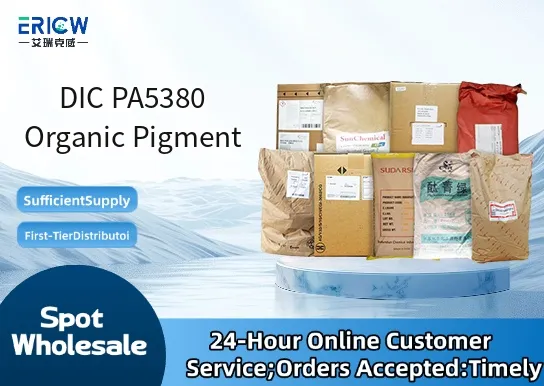
Q1: What is the primary chemical class and typical hue profile of DIC PA5380?
A: DIC PA5380 is a high-performance perylene-based organic pigment, offering strong violet-red to maroon shades with excellent chroma and clean undertones. Its molecular structure provides inherent resistance to aggregation and supports uniform dispersion in demanding polymer and coating systems.
Q2: Is DIC PA5380 suitable for use in food-contact plastics or regulated packaging applications?
A: DIC PA5380 is not pre-approved for direct food-contact applications under major global regulatory frameworks. It may be considered for non-migrating applications in outer packaging layers or industrial-use polymers, subject to full formulation compliance assessment and end-use testing by the responsible party.
Q3: How does DIC PA5380 perform in high-temperature processing environments, such as polypropylene or engineering thermoplastics?
A: This pigment demonstrates good thermal stability, typically supporting processing temperatures up to 280–300 °C for short residence times. It maintains color integrity and shows minimal degradation during standard extrusion and injection molding of polyolefins and certain engineering resins—though optimal performance depends on proper dispersion and stabilization within the host system.
Q4: What are recommended dispersion methods for achieving optimal color development and rheology control?
A: For best results, DIC PA5380 should be incorporated using high-shear compounding—such as twin-screw extrusion or high-speed dissolvers—often with compatible dispersants or carrier resins. Pre-dispersed concentrates (pellets or pastes) are widely used to ensure reproducibility, reduce dust handling, and improve dosage accuracy across batch production.
Contact With Us:
E-mail: wangxingqiang@ericwchem.com
Have a Questions? Call Us:
Add:
Building A1, Jiete Industrial Park, Huangpu District, Guangzhou City, Guangdong Province, China