English
 Español
 tiếng việt
 русский
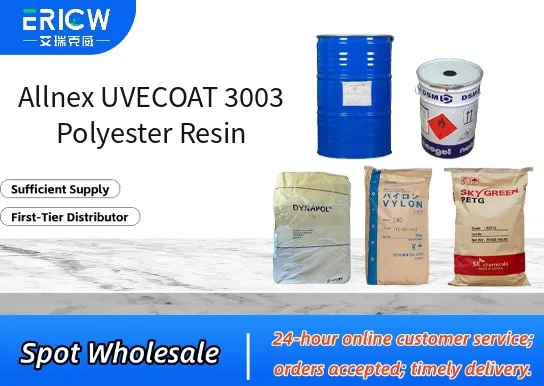
UV-curable aliphatic polyester resin offering excellent weather resistance and gloss retention.
Low viscosity enables high solids formulation with reduced need for reactive diluents.
Provides outstanding flexibility and impact resistance in cured films.
Compatible with common photoinitiators and other UV resins for broad formulating latitude.
Meets stringent regulatory requirements for low VOC and non-hazardous classification in many regions.
UV-curable clearcoats for automotive trim and interior plastic parts.
High-gloss decorative coatings for consumer electronics housings.
Protective topcoats for rigid PVC and ABS substrates in architectural applications.
Functional coatings for optical lenses requiring scratch resistance and clarity.
Industrial wood finishes where rapid cure and low-odor performance are critical.
| Chemical Type | Aliphatic unsaturated polyester |
| Product Form | Liquid resin |
| Appearance | Colorless to pale yellow, transparent liquid |
| Primary Applications | UV-curable protective and decorative coatings |
| Key Features | Low viscosity, high reactivity, excellent flexibility |
| Benefits | Reduced energy consumption, fast line speeds, enhanced substrate adhesion |
| Storage Stability | ≥6 months at 25 °C in sealed container |
| Recommended Photoinitiator Range | 3–8 wt% (e.g., TPO, 1173, or 819) |
Q1: What is the primary application of UVECOAT 3003 in UV-curable systems?
A: UVECOAT 3003 is a low-viscosity, trifunctional polyester acrylate resin designed primarily as a reactive diluent and film-forming binder in UV-curable coatings for industrial wood, plastic, and metal substrates—especially where high crosslink density, hardness, and chemical resistance are required.
Q2: How does UVECOAT 3003 compare to epoxy acrylates in terms of flexibility and yellowing resistance?
A: Compared to standard epoxy acrylates, UVECOAT 3003 offers improved flexibility and significantly better resistance to yellowing upon UV exposure and thermal aging, making it suitable for applications requiring long-term clarity and color stability.
Q3: Is UVECOAT 3003 compatible with common photoinitiators used in free-radical UV curing?
A: Yes, UVECOAT 3003 exhibits good compatibility with standard free-radical photoinitiators—including benzophenone derivatives, α-hydroxy ketones, and phosphine oxides—and responds efficiently under medium-pressure mercury lamp or LED-395 nm irradiation.
Q4: Can UVECOAT 3003 be blended with other resins to modify performance?
A: Yes, it is commonly blended with mono- or difunctional acrylates to adjust viscosity and reactivity, or with urethane acrylates to enhance toughness and adhesion—formulation adjustments should be validated for cure speed, final properties, and substrate compatibility.
Q5: What handling precautions should be observed during storage and processing?
A: Store in tightly sealed containers under inert atmosphere (e.g., nitrogen) at cool, dry conditions away from light and heat sources. Prolonged exposure to air may lead to surface skinning due to oxygen inhibition; stirring before use is recommended if settled or partially gelled.
Contact With Us:
E-mail: wangxingqiang@ericwchem.com
Have a Questions? Call Us:
Add:
Building A1, Jiete Industrial Park, Huangpu District, Guangzhou City, Guangdong Province, China