English
 Español
 tiếng việt
 русский
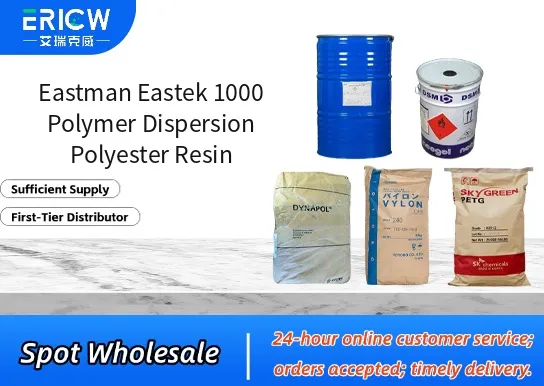
Waterborne polyester dispersion offering excellent film formation without coalescent aids.
Delivers high gloss, hardness, and chemical resistance in cured coatings.
Provides good compatibility with acrylic and epoxy dispersions for hybrid formulations.
Low VOC content supports compliance with stringent environmental and regulatory standards.
Stable at pH 7–9 and exhibits robust freeze-thaw stability (3 cycles at –4 °C to 25 °C).
Industrial maintenance coatings for metal substrates.
Waterborne coil coatings requiring durability and corrosion protection.
High-performance wood finishes demanding clarity and scratch resistance.
Refinish coatings for automotive plastic and metal components.
Architectural metal coatings for façades and roofing systems.
| Chemical Type | Polyester dispersion (waterborne) |
| Product Form | Opaque white liquid |
| Appearance | Homogeneous, slightly viscous dispersion |
| Solids Content | 45.0 ± 1.0 wt% |
| pH (25 °C) | 7.8–8.4 |
| Viscosity (Brookfield RVT, #2 spindle, 20 rpm, 25 °C) | 150–350 cP |
| Density (25 °C) | 1.02–1.05 g/cm³ |
| Primary Applications | Industrial coatings, coil coatings, refinish, architectural metal finishes |
Q1: What is the primary function of Eastman Eastek 1000 in coating and ink formulations?
A: Eastek 1000 functions as a film-forming polymer dispersion that enhances adhesion, flexibility, and surface durability in waterborne systems. It is commonly used to improve substrate bonding—especially on low-surface-energy plastics—and contributes to cohesive strength without compromising colloidal stability.
Q2: Is Eastek 1000 compatible with other common water-based resins and additives?
A: Yes, Eastek 1000 demonstrates broad compatibility with acrylic dispersions, polyurethane dispersions, and many water-soluble thickeners, defoamers, and coalescing agents. Compatibility should always be verified in the final formulation through stability testing under intended storage and processing conditions.
Q3: How does Eastek 1000 perform in terms of drying and film formation at ambient conditions?
A: As a self-crosslinking polyester dispersion, Eastek 1000 forms continuous, flexible films at room temperature with minimal coalescent requirement. Film formation is typically efficient across a range of humidity levels, though optimal performance is achieved when applied in well-ventilated environments with moderate air flow.
Q4: Can Eastek 1000 be used in food-contact compliant coatings?
A: Eastek 1000 is not pre-certified for direct food contact applications. Formulators intending to use it in such systems must conduct full regulatory evaluation—including migration testing and compliance verification—based on regional requirements and final formulation composition.
Contact With Us:
E-mail: wangxingqiang@ericwchem.com
Have a Questions? Call Us:
Add:
Building A1, Jiete Industrial Park, Huangpu District, Guangzhou City, Guangdong Province, China