English
 Español
 tiếng việt
 русский
High chroma and excellent color strength in both aqueous and solvent-based systems.
Outstanding thermal stability up to 220°C, suitable for high-temperature processing.
Good lightfastness (ISO 105-B02: Grade 7–8) and weather resistance in outdoor applications.
Low volatile organic compound (VOC) content, supporting eco-friendly formulation requirements.
Consistent batch-to-batch color reproducibility and dispersion stability in polymer matrices.
Automotive OEM and refinish coatings.
Engineering plastics including polyolefins and ABS.
Industrial coil coatings and metal decorating inks.
High-performance powder coatings for architectural and appliance finishes.
Water-based packaging inks for food-contact compliant substrates.
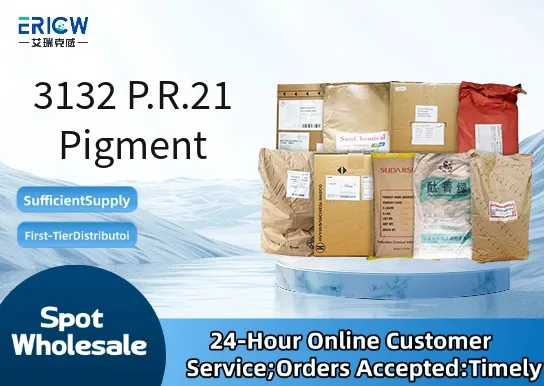
| Chemical Type | Azo pigment, classified as Pigment Red 21 (C.I. 12155) |
| Product Form | Fine free-flowing powder |
| Appearance | Reddish-orange powder with uniform particle size distribution |
| Primary Applications | Coatings, plastics, inks |
| Key Features | High tinting strength, good dispersibility, low dust generation |
| Benefits | Enhanced opacity, reduced dosage requirement, improved processability |
| Storage Conditions | Store in cool, dry place away from direct sunlight and moisture |
| Shelf Life | 24 months from date of manufacture under recommended conditions |
Q1: What is the primary chemical class and typical application domain for 3132 P.R.21 Pigment?
A: 3132 P.R.21 is a high-performance organic pigment belonging to the perylene derivative family. It is primarily used in demanding industrial coating systems—including automotive OEM and refinish coatings—as well as in select high-end plastic applications where exceptional lightfastness, thermal stability, and color strength are required.
Q2: Is 3132 P.R.21 Pigment suitable for food-contact or pharmaceutical packaging applications?
A: No—3132 P.R.21 is not certified for direct food contact or pharmaceutical use. It is formulated and qualified for industrial and decorative applications only. Customers requiring regulatory compliance for food-grade or medical packaging should consult our dedicated portfolio of FDA-compliant or EU-compliant pigments.
Q3: How does 3132 P.R.21 perform under elevated processing temperatures, such as during extrusion or baking?
A: This pigment exhibits excellent thermal stability, retaining its chromatic integrity and dispersion quality at temperatures commonly encountered in polymer processing (e.g., polyolefin extrusion) and coil coating or automotive paint baking cycles. Performance remains consistent without significant hue shift or decomposition under standard industrial conditions.
Q4: What are the recommended dispersion methods for optimal color development and stability?
A: For best results, high-shear dispersion using suitable wetting agents and dispersants is recommended—especially in solvent-borne and high-solid coating systems. In plastics, masterbatch preparation with compatible carrier resins ensures uniform distribution and maximizes tinting strength. Pre-dispersed forms are also available upon request.
Contact With Us:
E-mail: wangxingqiang@ericwchem.com
Have a Questions? Call Us:
Add:
Building A1, Jiete Industrial Park, Huangpu District, Guangzhou City, Guangdong Province, China