English
 Español
 tiếng việt
 русский
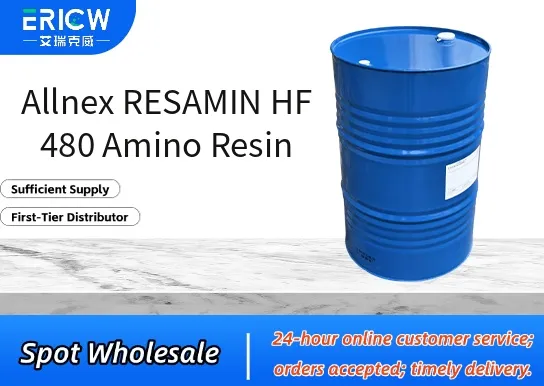
High-solids, low-viscosity formulation enabling excellent flow and leveling in coatings.
Low formaldehyde emission profile, supporting compliance with stringent environmental and occupational health regulations.
Enhanced hydrolytic stability compared to conventional melamine-formaldehyde resins.
Excellent compatibility with acrylic, polyester, and alkyd resin systems.
Fast cure response at moderate baking temperatures (140–160 °C), improving production efficiency.
Automotive OEM and refinish topcoats requiring high gloss and durability.
Industrial coil coatings for pre-painted metal substrates.
Appliance coatings demanding scratch resistance and chemical resistance.
Can coatings for food and beverage packaging with low migration potential.
General-purpose decorative and protective industrial finishes.
| Chemical Type | Melamine-formaldehyde co-resin, partially methylated and butylated |
| Product Form | Liquid |
| Appearance | Clear, pale yellow to amber liquid |
| Solids Content (wt%, ISO 3251) | ~80–82% |
| Viscosity (mPa·s, 25 °C, DIN ISO 2556) | ~150–300 |
| Density (g/cm³, 20 °C, ISO 1675) | ~1.22–1.26 |
| pH (10% aqueous solution) | 7.5–8.5 |
| Primary Applications | Crosslinker for thermosetting solventborne and high-solids industrial coatings |
Q1: What is the primary function of RESAMIN HF 480 in coating formulations?
A: RESAMIN HF 480 is a highly reactive, low-formaldehyde amino resin designed to act as a crosslinker for hydroxyl-functional resins—such as alkyds, acrylics, and polyesters—in thermosetting coatings. It enhances cure speed, hardness, chemical resistance, and film integrity under conventional or low-bake conditions.
Q2: How does RESAMIN HF 480 differ from standard melamine-formaldehyde resins?
A: RESAMIN HF 480 features a specially engineered low-free formaldehyde content and optimized reactivity profile, offering improved storage stability, reduced odor, and enhanced compatibility with acid-catalyzed systems—without compromising crosslinking efficiency or final film performance.
Q3: What catalysts are typically recommended for use with RESAMIN HF 480?
A: Acid catalysts such as p-toluenesulfonic acid (p-TSA), dinonylnaphthalene disulfonic acid (DNDSDA), or blocked acid systems are commonly used. Catalyst selection and dosage depend on the desired cure schedule, substrate type, and formulation pH; optimization is recommended via small-scale testing.
Q4: Is RESAMIN HF 480 suitable for waterborne coating systems?
A: Yes—RESAMIN HF 480 exhibits good compatibility with many water-reducible and hybrid aqueous-organic systems. Its solubility in common co-solvents (e.g., butanol, ethylene glycol monobutyl ether) supports stable dispersion in waterborne formulations, though compatibility should be verified case by case due to variations in resin architecture and ionic character.
Contact With Us:
E-mail: wangxingqiang@ericwchem.com
Have a Questions? Call Us:
Add:
Building A1, Jiete Industrial Park, Huangpu District, Guangzhou City, Guangdong Province, China