English
 Español
 tiếng việt
 русский
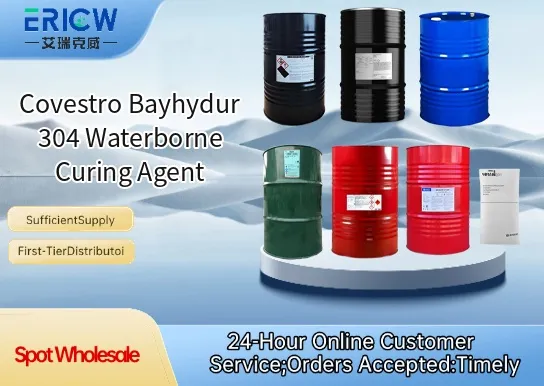
Low-VOC, waterborne aliphatic polyisocyanate crosslinker compliant with global environmental regulations.
Excellent hydrolytic stability for extended pot life in aqueous two-component systems.
Enables high-gloss, scratch-resistant, and weather-stable coatings with outstanding UV resistance.
Good compatibility with a broad range of waterborne acrylic, polyester, and polyurethane dispersions.
Fast ambient-cure performance without need for forced drying or high-temperature baking.
Automotive refinish clearcoats and basecoats.
Industrial maintenance coatings for metal and plastic substrates.
High-performance wood coatings for furniture and interior joinery.
Architectural façade and facade protection systems.
Coil coatings requiring excellent flexibility and corrosion resistance.
| Chemical Type | Aliphatic polyisocyanate (HDI-based) |
| Product Form | Waterborne dispersion |
| Appearance | Clear to slightly hazy, colorless to pale yellow liquid |
| NCO Content (wt %) | Approx. 12.5–13.5% |
| pH (at 23 °C) | 7.0–8.5 |
| Viscosity (23 °C, mPa·s) | 200–600 (Brookfield, spindle #3, 20 rpm) |
| Density (20 °C, g/cm³) | 1.08–1.12 |
| Primary Applications | Two-component waterborne polyurethane coatings |
Q1: What is Bayhydur 304, and how does it differ from solvent-based curing agents?
A: Bayhydur 304 is a waterborne polyisocyanate crosslinker based on hexamethylene diisocyanate (HDI) trimer chemistry. Unlike traditional solvent-based HDI curing agents, it is formulated as a stable aqueous dispersion, enabling lower VOC formulations while maintaining good reactivity and film performance in ambient- or forced-dry applications.
Q2: Which types of resins is Bayhydur 304 typically compatible with?
A: Bayhydur 304 is designed for use with waterborne hydroxyl-functional acrylics, polyesters, and hybrid dispersions. It offers good compatibility and storage stability when properly formulated, though compatibility testing with specific resin systems is recommended prior to full-scale production.
Q3: How should Bayhydur 304 be stored and handled to maintain stability?
A: Store in original sealed containers at temperatures between 5 °C and 30 °C, away from freezing and prolonged exposure to high humidity or direct sunlight. Avoid contamination with water-miscible solvents or amines, and always ensure thorough mixing before use to maintain homogeneity.
Q4: Does Bayhydur 304 require catalysts, and what is its pot life like?
A: Catalysts are generally not required for ambient-cure systems, though tin- or amine-based catalysts may be used to accelerate cure under low-temperature or high-humidity conditions. Pot life varies significantly depending on formulation pH, co-solvent content, and temperature — typical working times range from several hours to over 24 hours in well-balanced systems.
Contact With Us:
E-mail: wangxingqiang@ericwchem.com
Have a Questions? Call Us:
Add:
Building A1, Jiete Industrial Park, Huangpu District, Guangzhou City, Guangdong Province, China