English
 Español
 tiếng việt
 русский
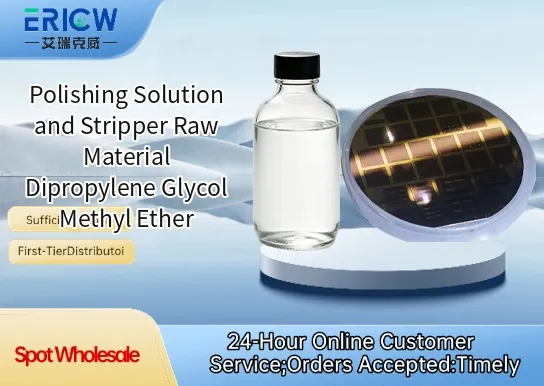
High solvency power for resins, lacquers, and cured polymer films without aggressive corrosion to common substrates.
Low volatility (boiling point ~190°C) enabling extended working time and reduced VOC emissions versus acetone or MEK.
Excellent water miscibility and co-solvency performance in aqueous-organic polishing and stripping formulations.
Non-halogenated, non-ozone-depleting chemistry with favorable HSE profile for industrial handling.
Stable under ambient storage conditions; compatible with stainless steel, polyethylene, and fluoropolymer-lined equipment.
Active solvent component in precision optical lens polishing solutions for anti-reflective and hard-coat removal.
Key carrier and swelling agent in semiconductor photoresist strippers for post-etch residue cleaning.
Formulation base for automotive clear-coat correction fluids and paint defect removal systems.
Solvent extender in industrial metal surface preparation prior to electroplating or coating adhesion enhancement.
Co-solvent in high-performance inkjet printhead maintenance fluids for pigment and binder dissolution.
| Chemical Type | Glycol ether — dipropylene glycol monomethyl ether (DPGME) |
| Chemical Formula | C6H14O3 |
| Molecular Weight | 134.17 g/mol |
| Appearance | Clear, colorless liquid |
| Odor | Mild, characteristic ether-like odor |
| Boiling Point (760 mmHg) | 188–190°C |
| Density (20°C) | 0.905–0.910 g/cm³ |
| Water Solubility | Complete miscibility in all proportions |
| Common Compatible Systems | Suitability |
| Aqueous alkaline stripper concentrates (e.g., NaOH + chelants) | Highly Recommended – Enhances resin swelling and hydrolysis kinetics without phase separation |
| Organic solvent blends (e.g., with NMP, GBL, or ethyl lactate) | Highly Recommended – Fully miscible; improves viscosity control and substrate wetting |
| Acid-catalyzed polishing emulsions (e.g., phosphoric acid-based) | Recommended – Stable at pH ≥ 2.5; avoid prolonged exposure below pH 2.0 |
| UV-curable acrylate residue removers | Suitable – Effective for partial cure removal; may require thermal activation above 45°C for full efficacy |
Q1: What is the CAS Registry Number for Dipropylene Glycol Methyl Ether?
A: The CAS number is 34590-94-8 (primary isomer, 1-methoxy-2-(2-propoxy)propane).
Q2: What is the typical recommended concentration range when used in aqueous polishing formulations?
A: 5–20 wt% in final ready-to-use formulations; optimal performance observed at 10–15 wt% for balanced solvency, evaporation rate, and safety margin.
Q3: How does DPGME compare to Propylene Glycol Methyl Ether (PGME) in stripping efficiency?
A: DPGME offers higher boiling point and lower vapor pressure than PGME, resulting in improved film-forming ability, reduced flash risk, and superior penetration into crosslinked coatings—though slightly slower initial dissolution kinetics.
Q4: Is DPGME compliant with REACH and TSCA regulations?
A: Yes—fully pre-registered under REACH (EC No. 251-965-8) and listed on the TSCA Inventory (CAS 34590-94-8); no SVHCs identified per current ECHA updates.
Q5: Does DPGME exhibit extractable residue concerns in pharmaceutical or medical device cleaning validation?
A: DPGME is not classified as a high-risk leachable; it demonstrates low residual affinity on stainless steel and glass surfaces and is readily rinsed with water or IPA—validated per USP <846> for trace solvent clearance in Class C cleaning processes.
Contact With Us:
E-mail: wangxingqiang@ericwchem.com
Have a Questions? Call Us:
Add:
Building A1, Jiete Industrial Park, Huangpu District, Guangzhou City, Guangdong Province, China