English
 Español
 tiếng việt
 русский
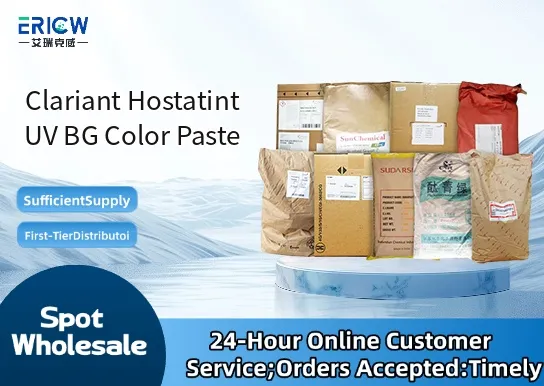
Highly concentrated, solvent-free color paste for precise UV-curable ink formulation.
Excellent dispersion stability in acrylate-based UV systems without sedimentation or flocculation.
Optimized for low migration and high lightfastness in demanding packaging applications.
Compliant with global food-contact regulations (EU 10/2011, FDA 21 CFR §175.105) when used as directed.
Consistent batch-to-batch color strength and hue reproducibility for reliable production scaling.
UV-curable flexographic inks for flexible food packaging films.
UV offset inks used in high-speed commercial printing on coated paper and board.
Screen-printed UV inks for labels and shrink sleeves requiring vibrant blue-green shades.
UV digital inks for industrial inkjet printing on rigid plastics and metalized substrates.
Specialty coatings for decorative laminates and cosmetic packaging requiring UV resistance.
| Chemical Type | Organic pigment dispersion in reactive acrylate oligomer carrier |
| Product Form | Paste (non-volatile, solvent-free) |
| Appearance | Homogeneous, viscous blue-green paste |
| Primary Applications | UV-curable inks and coatings |
| Key Features | Low viscosity, high transparency, excellent gloss retention |
| Benefits | Reduced formulation complexity, improved jetting reliability, enhanced final print durability |
| Storage Conditions | Store at 10–30 °C; protect from freezing and direct sunlight |
| Shelf Life | 12 months from date of manufacture under recommended storage conditions |
Q1: What is the primary application of Hostatint UV BG Color Paste?
A: Hostatint UV BG Color Paste is a specialized pigment dispersion designed for coloring UV-curable coatings, inks, and adhesives—particularly where high color strength, excellent photostability, and minimal impact on cure speed are required.
Q2: Is this color paste compatible with common UV-curable resin systems?
A: Yes, Hostatint UV BG Color Paste is formulated for compatibility with standard acrylate-based UV resins—including monofunctional, difunctional, and multifunctional monomers and oligomers—as well as cationic UV systems, though compatibility testing under actual formulation conditions is recommended.
Q3: How should this paste be incorporated into a UV formulation?
A: It is typically added during the pre-mix stage under low-shear conditions to ensure homogeneous dispersion. Avoid high-shear mixing that may destabilize the pigment dispersion or introduce air entrapment detrimental to UV film quality.
Q4: Does Hostatint UV BG affect the UV curing performance of the final system?
A: When used within typical dosage ranges, it exhibits low interference with photoinitiator activity and maintains good surface cure and through-cure characteristics—however, optimal dosing depends on pigment loading, film thickness, and UV lamp output, so process validation is advised.
Q5: What are the key handling and storage recommendations?
A: Store in tightly sealed original containers at temperatures between 5 °C and 30 °C, protected from direct sunlight and freezing. Stir gently before use if sedimentation occurs; do not dilute with solvents unless validated for compatibility and stability.
Contact With Us:
E-mail: wangxingqiang@ericwchem.com
Have a Questions? Call Us:
Add:
Building A1, Jiete Industrial Park, Huangpu District, Guangzhou City, Guangdong Province, China