English
 Español
 tiếng việt
 русский
Excellent clarity and gloss for high-end aesthetic applications.
Good chemical resistance to oils, greases, and common household cleaners.
Outstanding toughness and impact resistance at room and low temperatures.
Easy processability via injection molding and extrusion without drying.
Compliant with FDA 21 CFR §177.1810 for repeated-use food-contact applications.
Reusable food and beverage containers (e.g., water pitchers, blender jars).
Medical device housings requiring transparency and sterilizability.
Consumer electronics enclosures demanding scratch resistance and dimensional stability.
Point-of-purchase displays and retail fixtures requiring optical clarity and durability.
Personal care packaging such as cosmetic jars and dispensers.
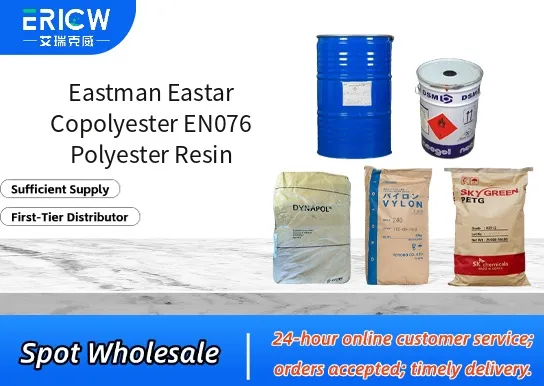
| Chemical Type | Copolyester (PET-based, cyclohexanedimethanol-modified) |
| Product Form | Pellets |
| Appearance | Transparent, translucent white or natural-colored pellets |
| Primary Applications | Food-contact packaging, medical devices, durable consumer goods |
| Key Features | Clarity, toughness, chemical resistance, melt processability |
| Benefits | No drying required prior to processing; excellent dimensional stability |
| Regulatory Compliance | FDA 21 CFR §177.1810; EU Regulation (EU) No 10/2011 compliant |
Q1: What is the primary functional role of Eastman Eastar EN076 in polymer formulations?
A: Eastar EN076 functions as a reactive polyester-based modifier or compatibilizer, primarily used to enhance melt processability, improve interfacial adhesion between dissimilar polymers, and increase toughness in blended systems—especially in polyolefin- or biopolymer-based compounds.
Q2: Is Eastar EN076 suitable for food-contact applications?
A: Eastar EN076 is designed for use in applications where regulatory compliance is required; however, final food-contact suitability depends on the complete formulation, processing conditions, and applicable regional regulations. Users must conduct full regulatory evaluation—including migration testing—under intended end-use conditions.
Q3: How is Eastar EN076 typically incorporated into thermoplastic systems?
A: It is generally introduced via dry blending with base resins prior to extrusion or injection molding. Due to its reactive functionality, optimal dispersion and residence time during melt processing are important to achieve effective compatibilization without excessive degradation.
Q4: Does Eastar EN076 require special drying before processing?
A: Yes—like many polyester-based materials, Eastar EN076 is hygroscopic and should be dried prior to high-temperature melt processing. Recommended drying conditions are typically 60–70 °C under vacuum or dehumidified air for 2–4 hours, depending on moisture content and equipment capabilities.
Contact With Us:
E-mail: wangxingqiang@ericwchem.com
Have a Questions? Call Us:
Add:
Building A1, Jiete Industrial Park, Huangpu District, Guangzhou City, Guangdong Province, China