English
 Español
 tiếng việt
 русский
Excellent abrasion and tear resistance for demanding dynamic applications.
Good low-temperature flexibility down to –40 °C.
High transparency and clarity with consistent optical performance.
Outstanding processability via extrusion, injection molding, and calendering.
Compatible with common plasticizers and additives for formulation flexibility.
Medical tubing and fluid delivery systems requiring biocompatibility support.
High-performance automotive interior trim and soft-touch surfaces.
Wearable device components including straps, housings, and seals.
Industrial hoses and pneumatic tubing exposed to repeated flexing.
Consumer electronics protective cases and gasketing materials.
| Chemical Type | Aliphatic polyester-based thermoplastic polyurethane |
| Product Form | Pellets |
| Appearance | Translucent, off-white pellets |
| Shore D Hardness (ASTM D2240) | 60 ± 2 |
| Melt Flow Rate (210 °C/2.16 kg, ASTM D1238) | 12–18 g/10 min |
| Density (ASTM D792) | 1.18–1.20 g/cm³ |
| Primary Applications | Medical devices, automotive interiors, wearables, industrial tubing |
| Key Features | Clarity, flexibility, processability, chemical resistance |
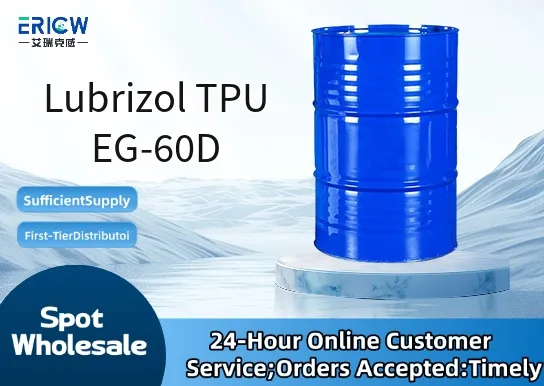
Q1: What is Lubrizol TPU EG-60D and how does it differ from standard TPU resins?
A: Lubrizol TPU EG-60D is a specialty thermoplastic polyurethane elastomer designed for enhanced processability and surface performance in extrusion and injection molding applications. Unlike conventional TPUs, it features optimized melt flow characteristics and reduced die swell, enabling improved dimensional stability and smoother surface finish in demanding thin-wall or high-gloss parts.
Q2: Is Lubrizol TPU EG-60D suitable for medical or food-contact applications?
A: Lubrizol TPU EG-60D is formulated to meet general requirements for biocompatibility and low extractables, and has been evaluated for use in certain non-invasive medical device components and food-contact-adjacent applications. However, final regulatory compliance depends on the full formulation, processing conditions, and end-use configuration—users must conduct their own validation per applicable regional regulations.
Q3: How should Lubrizol TPU EG-60D be dried prior to processing?
A: To ensure optimal mechanical properties and melt stability, Lubrizol TPU EG-60D should be thoroughly dried using desiccant-assisted drying. Typical drying conditions are 70–80 °C for 2–4 hours, with residual moisture maintained below 0.02% by weight. Drying time may vary depending on material history, ambient humidity, and hopper design.
Q4: Can Lubrizol TPU EG-60D be blended with other polymers?
A: Yes, Lubrizol TPU EG-60D exhibits good compatibility with several engineering thermoplastics—including certain grades of PC, ABS, and PET—enabling tailored blends for improved impact resistance, flexibility, or surface feel. Compatibility testing and rheological assessment are recommended for each intended blend system to confirm phase dispersion and long-term stability.
Contact With Us:
E-mail: wangxingqiang@ericwchem.com
Have a Questions? Call Us:
Add:
Building A1, Jiete Industrial Park, Huangpu District, Guangzhou City, Guangdong Province, China