English
 Español
 tiếng việt
 русский
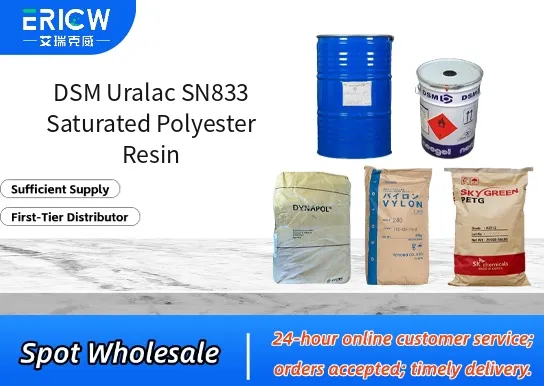
Highly crosslinkable with melamine-formaldehyde resins for excellent thermal and chemical resistance.
Low viscosity enables easy formulation and high-solids coating systems with reduced VOC emissions.
Outstanding gloss retention and color stability after curing and long-term weather exposure.
Consistent batch-to-batch performance ensured by DSM’s stringent quality control and polymerization process.
Designed for powder coating applications requiring smooth film formation and excellent flow/leveling.
Architectural aluminum extrusion coatings (e.g., curtain walls, window frames).
Appliance coatings for refrigerators, washing machines, and ovens.
Outdoor furniture and garden equipment finishes.
Automotive non-critical exterior trim components.
General industrial metal finishing requiring durable, decorative, and corrosion-resistant layers.
| Chemical Type | Saturated polyester resin |
| Product Form | Free-flowing white to off-white granules |
| Appearance | Granular, free of lumps or discoloration |
| Acid Value (mg KOH/g) | 24–28 |
| Hydroxyl Value (mg KOH/g) | 18–22 |
| Gardner Color (10% in MIBK) | ≤ 2 |
| Softening Point (°C, Ring & Ball) | 75–82 |
| Primary Applications | Powder coatings for architectural and appliance markets |
Q1: What is the primary application of Uralac SN833 in powder coating formulations?
A: Uralac SN833 is specifically designed as a low-viscosity, high-reactivity saturated polyester resin for use in high-gloss, durable thermoset powder coatings—particularly where excellent flow, leveling, and resistance to yellowing under UV exposure are required.
Q2: Is Uralac SN833 compatible with common crosslinkers used in polyester-based powder coatings?
A: Yes, Uralac SN833 is formulated to be highly compatible with standard glycidyl-functional crosslinkers such as triglycidyl isocyanurate (TGIC) and hydroxyalkyl amide (HAA) systems, enabling robust cure profiles across conventional and low-cure temperature conditions.
Q3: How does Uralac SN833 contribute to film appearance and mechanical performance?
A: Its balanced molecular weight distribution and controlled acid value support exceptional melt viscosity behavior during curing, resulting in superior surface smoothness, high gloss retention, and improved flexibility without compromising hardness or chemical resistance.
Q4: Can Uralac SN833 be used in low-bake or ultra-low-bake powder coating systems?
A: Yes, Uralac SN833 demonstrates good reactivity at reduced cure temperatures, making it suitable for formulations targeting energy-efficient curing cycles—though optimal performance requires careful matching with reactive crosslinkers and catalysts.
Contact With Us:
E-mail: wangxingqiang@ericwchem.com
Have a Questions? Call Us:
Add:
Building A1, Jiete Industrial Park, Huangpu District, Guangzhou City, Guangdong Province, China