English
 Español
 tiếng việt
 русский
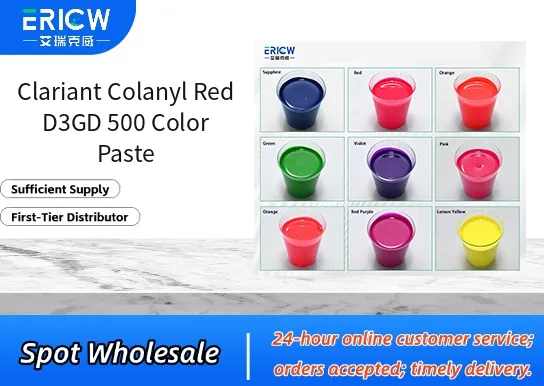
High chroma red shade with excellent lightfastness and thermal stability up to 240 °C.
Optimized for low migration in polyolefin compounds, meeting stringent regulatory requirements for food-contact applications.
Excellent dispersion performance in PP, PE, and PS matrices without requiring additional dispersing aids.
Consistent batch-to-batch color reproducibility ensured by Clariant’s proprietary pigment stabilization technology.
Free of heavy metals, phthalates, and restricted azo dyes—compliant with REACH, RoHS, and FDA 21 CFR §178.3297.
Polypropylene (PP) automotive interior parts including dashboards, trim, and air vents.
Food-grade polyethylene (PE) packaging films and containers.
Household appliances housings made from impact-modified polystyrene (PS).
Medical device components requiring biocompatibility and color stability during gamma sterilization.
Technical injection-molded parts for consumer electronics enclosures.
| Chemical Type | Organic pigment dispersion (Benzimidazolone-based) |
| Product Form | Concentrated liquid color paste |
| Appearance | Homogeneous, viscous red paste |
| Primary Applications | Polyolefins (PP, HDPE, LDPE), polystyrene (PS), ABS |
| Key Features | Low migration, high thermal stability, excellent dispersion |
| Benefits | Reduced processing time, consistent color matching, compliance-ready formulation |
| VOC Content | <1.0 wt% (as supplied) |
| Storage Stability | 12 months at 5–30 °C in sealed original container |
Q1: What types of polymer systems is Colanyl Red D3GD 500 compatible with?
A: Colanyl Red D3GD 500 is formulated for use in polyolefins—particularly PP and HDPE—as well as certain engineering thermoplastics. It demonstrates good thermal stability during standard melt processing conditions and is not recommended for high-temperature polymers such as PEEK or polyimides without prior compatibility testing.
Q2: How should this color paste be incorporated into a polymer compound?
A: The paste is typically introduced via side-stuffer feeder, gravimetric dosing unit, or pre-blended masterbatch dilution. For optimal dispersion, it is recommended to avoid direct addition to cold feed throat; instead, integrate downstream where melt temperature ensures efficient wetting and distribution.
Q3: Is Colanyl Red D3GD 500 suitable for applications requiring food contact compliance?
A: This grade is designed for non-food-contact industrial applications. While Clariant offers food-contact-compliant alternatives, Colanyl Red D3GD 500 has not been evaluated or certified against food safety regulations such as FDA 21 CFR or EU Framework Regulation (EC) No 1935/2004.
Q4: What is the typical dosage range when using this paste in polypropylene?
A: Dosage depends on the desired shade intensity and base resin opacity, but it is generally used at low concentrations—typically ranging from 0.1% to 2% by weight in final compounded material. Optimal loading should be determined through lab-scale trials under representative processing conditions.
Contact With Us:
E-mail: wangxingqiang@ericwchem.com
Have a Questions? Call Us:
Add:
Building A1, Jiete Industrial Park, Huangpu District, Guangzhou City, Guangdong Province, China