English
 Español
 tiếng việt
 русский
Highly crosslinked methyl-phenyl silicone resin offering excellent thermal stability and oxidative resistance.
Low surface energy and superior release performance in high-temperature molding applications.
Compatible with organic resins, enabling effective formulation in coatings, adhesives, and composites.
Soluble in common aromatic and ketonic solvents (e.g., xylene, MEK), facilitating easy processing and integration.
Provides enhanced hardness, gloss retention, and weatherability in protective topcoats and specialty finishes.
High-performance release coatings for industrial molds and composite manufacturing tools.
Thermal barrier and protective topcoats for exhaust systems and engine components.
Heat-resistant primers and binders in ceramic and refractory coatings.
Modifier in silicone-modified alkyd and polyester resin systems for architectural and industrial coatings.
Key ingredient in specialty anti-fouling and non-stick coatings for food-processing equipment.
| Chemical Type | Methyl-phenyl silicone resin |
| Product Form | Solids in solvent (xylene/MEK blend) |
| Appearance | Clear to slightly hazy, pale yellow liquid |
| Non-Volatile Content | 50 ± 2 wt% |
| Viscosity (25°C, Brookfield RV, spindle #3, 20 rpm) | 1,800–2,400 cP |
| Gel Time (150°C, on glass) | Approx. 12–18 minutes |
| Key Features | Thermal stability up to 250°C continuous, low Tg, excellent film integrity |
| Primary Applications | Release coatings, heat-resistant finishes, silicone-modified hybrid systems |
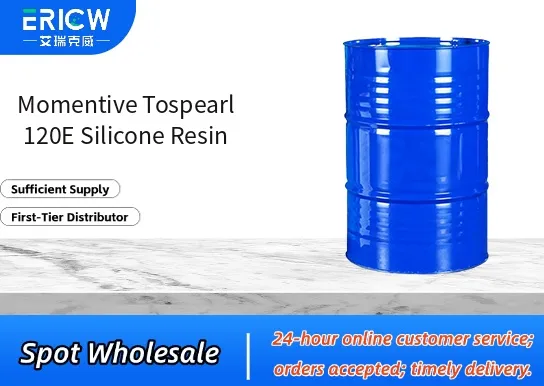
Q1: What is the primary function of Tospearl 120E in coating and ink formulations?
A: Tospearl 120E is a hydrophobic silica-modified silicone resin designed to provide controlled matting, improved surface slip, and enhanced scratch resistance without significantly affecting gloss uniformity or transparency. It functions as a multifunctional additive that supports both aesthetic and performance attributes in solvent-based and high-solids systems.
Q2: Is Tospearl 120E compatible with UV-curable systems?
A: Yes, Tospearl 120E demonstrates good compatibility with many UV-curable acrylate and epoxy-acrylate systems. Its silicone-silica hybrid structure allows for effective dispersion and minimal interference with photoinitiator activity, though optimal performance should be verified through formulation-specific testing under intended cure conditions.
Q3: How should Tospearl 120E be incorporated into a formulation?
A: It is typically added during the let-down or post-additive stage using high-shear mixing to ensure uniform dispersion. Pre-dispersion in a compatible solvent or carrier resin is recommended for optimal integration, especially in low-viscosity systems. Avoid prolonged high-temperature processing prior to final dispersion to preserve its functional integrity.
Q4: Does Tospearl 120E contribute to improved substrate wetting or leveling?
A: While not primarily classified as a wetting or leveling agent, Tospearl 120E can support more consistent film formation and reduced orange peel due to its influence on surface rheology and interfacial behavior—particularly when used in conjunction with other silicone or fluorosurfactant additives.
Contact With Us:
E-mail: wangxingqiang@ericwchem.com
Have a Questions? Call Us:
Add:
Building A1, Jiete Industrial Park, Huangpu District, Guangzhou City, Guangdong Province, China