English
 Español
 tiếng việt
 русский
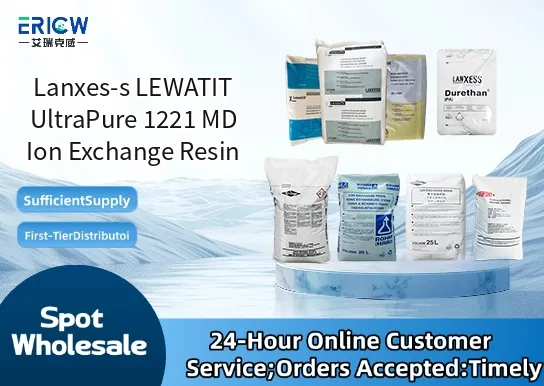
Highly purified, low-extractable anion exchange resin specifically engineered for ultra-high-purity water production.
Optimized macroporous matrix ensures exceptional chemical stability and resistance to organic fouling.
Low total organic carbon (TOC) leaching profile, validated for pharmaceutical-grade water systems.
Consistent spherical bead morphology with narrow particle size distribution for uniform hydraulic performance.
Compliant with USP <841>, EP 2.2.58, and FDA 21 CFR §173.250 for use in regulated water purification processes.
Final polishing stage in pharmaceutical water systems (PW, WFI, and Pure Steam condensate treatment).
Ultrapure water (UPW) generation for semiconductor manufacturing and microelectronics rinsing.
Critical pretreatment and polishing in biopharmaceutical process water loops.
Removal of trace anions (e.g., silica, nitrate, sulfate) from high-purity laboratory and analytical water systems.
| Chemical Type | Strong Base Anion Exchange Resin (Type I, Quaternary Ammonium) |
| Product Form | Moist, spherical beads |
| Appearance | Amber, translucent beads |
| Functional Group | –N⁺(CH₃)₃ |
| Matrix Structure | Macroporous polystyrene-divinylbenzene copolymer |
| Ionic Form | Chloride (Cl⁻) |
| Particle Size Range (mm) | 0.45 – 0.90 |
| Uniformity Coefficient | ≤ 1.6 |
Q1: What is the primary application of LEWATIT UltraPure 1221 MD in pharmaceutical water systems?
A: LEWATIT UltraPure 1221 MD is specifically designed for final polishing in high-purity water production—such as Water for Injection (WFI) and purified water—where ultra-low levels of ionic contaminants, trace metals, and organic leachables must be consistently removed.
Q2: How does the "MD" designation differentiate this resin from standard LEWATIT 1221 variants?
A: The "MD" (Medical Device-grade) designation indicates enhanced manufacturing controls, stricter raw material sourcing, and additional validation support to meet stringent requirements for use in regulated biopharmaceutical and medical device manufacturing environments.
Q3: Is LEWATIT UltraPure 1221 MD suitable for use in single-pass or recirculating water purification systems?
A: Yes—it is validated for both configurations. Its high chemical stability and low pressure drop make it especially well-suited for continuous recirculation loops common in pharmaceutical water distribution systems.
Q4: What regeneration protocol is recommended for maintaining optimal performance?
A: Standard sodium chloride regeneration is typically used, with concentration and flow rate optimized based on system design and feedwater quality. Regeneration efficiency is supported by the resin’s uniform bead structure and high crosslinking, enabling consistent capacity recovery over multiple cycles.
Contact With Us:
E-mail: wangxingqiang@ericwchem.com
Have a Questions? Call Us:
Add:
Building A1, Jiete Industrial Park, Huangpu District, Guangzhou City, Guangdong Province, China