English
 Español
 tiếng việt
 русский
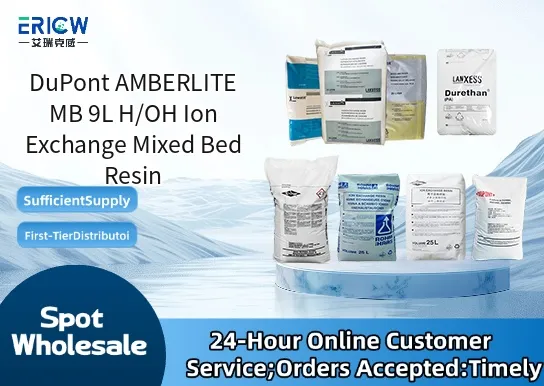
Pre-mixed, balanced ratio of strong acid cation (H⁺ form) and strong base anion (OH⁻ form) resins for consistent high-purity water production.
Optimized particle size distribution and uniform bead structure to minimize pressure drop and maximize service cycle efficiency.
Low total organic carbon (TOC) extractables, supporting ultrapure water (UPW) requirements in semiconductor and pharmaceutical applications.
High chemical stability in repeated regeneration cycles, ensuring long operational life under standard mixed-bed operating conditions.
Designed for rapid and complete regeneration with conventional acid–base regenerants, minimizing rinse time and wastewater volume.
Final polishing step in high-purity water systems for semiconductor manufacturing.
Ultrapure water (UPW) generation for pharmaceutical-grade water (PW, WFI, or Purified Water per USP/EP).
Critical boiler feedwater polishing in power generation facilities requiring low silica and conductivity.
Lab-scale and pilot-scale deionization systems requiring reproducible, low-sodium, low-silica effluent.
Electronics manufacturing process water where trace ion removal and resistivity >18.0 MΩ·cm are essential.
| Chemical Type | Strong acid cation (H⁺) / strong base anion (OH⁻) mixed bed resin |
| Product Form | Pre-mixed, ready-to-use wet resin blend |
| Appearance | Uniform amber-to-light-brown spherical beads (cation) mixed with white-to-cream spherical beads (anion) |
| Primary Applications | Final polishing for ultrapure water systems |
| Key Features | Low TOC leachables, optimized particle sizing, high regeneration efficiency |
| Benefits | Consistent resistivity >18.0 MΩ·cm, reduced rinse water consumption, extended service run length |
| Storage Conditions | Store at 5–35°C; avoid freezing and direct sunlight |
| Regeneration Compatibility | Standard sulfuric acid (H₂SO₄) and sodium hydroxide (NaOH) solutions |
Q1: What is the primary function of AMBERLITE MB 9L in high-purity water systems?
A: AMBERLITE MB 9L is a pre-mixed, fully regenerated ion exchange resin combining strong acid cation (H⁺ form) and strong base anion (OH⁻ form) resins. Its main function is to remove residual ionic contaminants from deionized water streams, delivering ultrapure water with resistivity typically exceeding 18 MΩ·cm and very low total organic carbon (TOC) levels.
Q2: How does MB 9L differ from conventional two-bed or separate mixed-bed resins?
A: Unlike traditional two-bed systems requiring separate cation and anion columns—or field-mixed resins that risk uneven blending—MB 9L is factory-premixed and pre-equilibrated in the H⁺/OH⁻ form. This ensures consistent stoichiometric balance, minimizes risk of sodium or silica leakage, and simplifies installation and regeneration logistics for critical polishing applications.
Q3: Is MB 9L suitable for pharmaceutical or semiconductor-grade water production?
A: Yes—MB 9L is widely deployed in final polishing stages for USP Purified Water (PW), Water for Injection (WFI) distribution loops, and semiconductor process water systems. It meets stringent requirements for low extractables, minimal particle generation, and consistent removal of trace ions and weakly ionized species such as silica and boron.
Q4: What are key operational considerations during commissioning and service life?
A: Prior to service, MB 9L requires thorough backwashing to separate and settle the resin bed and remove fines. During operation, it is sensitive to oxidants (e.g., chlorine, ozone) and organic fouling; feed water should be pre-treated with activated carbon and/or ultrafiltration where necessary. End-of-service is typically indicated by rising conductivity or silica breakthrough, rather than fixed time or volume limits.
Contact With Us:
E-mail: wangxingqiang@ericwchem.com
Have a Questions? Call Us:
Add:
Building A1, Jiete Industrial Park, Huangpu District, Guangzhou City, Guangdong Province, China