English
 Español
 tiếng việt
 русский
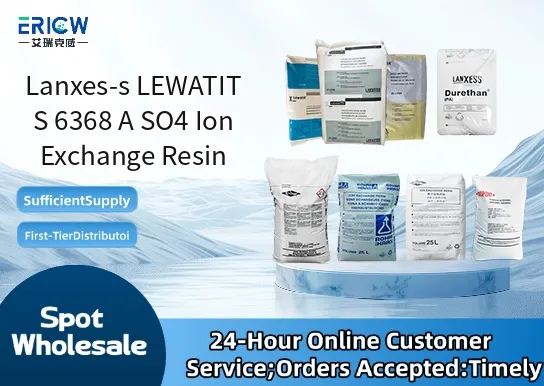
Highly selective for sulfate (SO₄²⁻) removal in complex anion matrices.
Stable polyacrylate-based matrix offering excellent chemical and osmotic stability.
Optimized bead uniformity and low fines content for consistent hydraulic performance.
Regenerable with sodium chloride (NaCl), enabling cost-effective operational cycles.
Low pressure drop design suitable for both fixed-bed and moving-bed ion exchange systems.
Removal of sulfate from industrial process water in mining and metallurgical operations.
Treatment of sulfate-rich groundwater for potable water supply compliance.
Pre-treatment step in pharmaceutical water systems to meet pharmacopeial sulfate limits.
Effluent polishing in chemical manufacturing to reduce sulfate discharge to regulatory levels.
Desulfation of brackish water prior to reverse osmosis membrane protection.
| Chemical Type | Strong Base Anion Exchange Resin (Type I, Quaternary Ammonium) |
| Product Form | Moist, spherical beads |
| Appearance | Off-white to light yellow, translucent beads |
| Functional Group | Triethylbenzylammonium |
| Matrix Structure | Crosslinked polyacrylate |
| Ion Form | Chloride (Cl⁻) — supplied; convertible to sulfate (SO₄²⁻) form |
| Particle Size Range | 0.3–1.2 mm (95% retained on 0.3 mm sieve) |
| Moisture Content | Approx. 48–52% (w/w) |
Q1: What is the primary functional group and ionic form of LEWATIT S 6368 A SO4?
A: LEWATIT S 6368 A SO4 is a strongly acidic cation exchange resin in the sodium form, featuring sulfonic acid functional groups bound to a styrene-divinylbenzene matrix. The "SO4" designation indicates it is supplied pre-conditioned with sulfate counterions for specific softening or selective divalent cation removal applications.
Q2: Can this resin be used for potable water treatment?
A: Yes — LEWATIT S 6368 A SO4 is suitable for drinking water applications when operated within validated process parameters and regenerated using food-grade regenerants. It complies with common regulatory frameworks for ion exchange resins intended for indirect contact with potable water, subject to proper system design, rinsing protocols, and local authority approval.
Q3: How does LEWATIT S 6368 A SO4 differ from standard Na⁺-form strong acid cation resins?
A: Unlike conventional Na⁺-form resins optimized for general hardness removal, S 6368 A SO4 is specially formulated with controlled crosslinking and particle size distribution to enhance selectivity for calcium and magnesium over monovalent ions — particularly beneficial in high-sulfate feedwaters where sulfate competition may influence regeneration efficiency and leakage behavior.
Q4: What are key operational considerations during regeneration?
A: Regeneration should use sodium sulfate or sodium chloride solutions under controlled flow rates and contact times. Avoid excessive regenerant concentrations or rapid rinse cycles, as these may compromise bed uniformity or increase sulfate breakthrough. Temperature sensitivity is moderate; performance remains stable across typical ambient to warm process water temperatures (5–40 °C), but prolonged exposure above 50 °C is not recommended.
Contact With Us:
E-mail: wangxingqiang@ericwchem.com
Have a Questions? Call Us:
Add:
Building A1, Jiete Industrial Park, Huangpu District, Guangzhou City, Guangdong Province, China