English
 Español
 tiếng việt
 русский
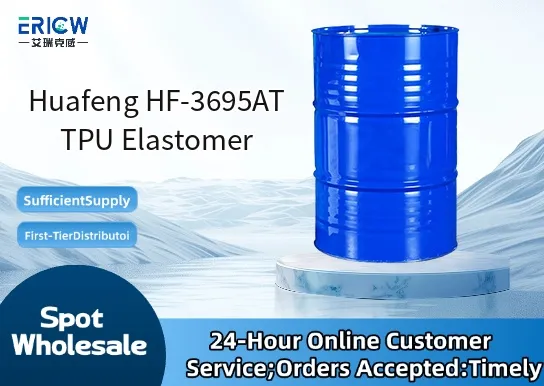
Excellent abrasion resistance for high-durability end products.
Outstanding low-temperature flexibility down to –30 °C.
Good oil and grease resistance suitable for demanding industrial environments.
High tensile strength and elongation retention after thermal aging.
Excellent melt processability via extrusion, injection molding, and calendering.
Automotive interior trim components (e.g., gear knobs, armrests).
Industrial hoses and pneumatic tubing requiring flex fatigue resistance.
Protective coatings and overmolding for metal and plastic substrates.
Specialty footwear midsoles and outsoles demanding rebound and wear performance.
Conveyor belts and drive belts in material handling systems.
| Chemical Type | Thermoplastic Polyurethane (TPU), Aliphatic Polyester-based |
| Product Form | Pellets |
| Appearance | Off-white to light yellow translucent granules |
| Hardness (Shore A) | 95 ± 2 |
| Melt Flow Index (210 °C / 5 kg) | 12–16 g/10 min |
| Tensile Strength | ≥ 42 MPa |
| Elongation at Break | ≥ 550 % |
| Density | 1.18–1.20 g/cm³ |
Q1: What are the key processing advantages of HF-3695AT compared to conventional TPU grades?
A: HF-3695AT is engineered for enhanced melt processability, offering improved flow stability and reduced extrusion pressure during melt processing. Its optimized molecular architecture supports consistent dispersion in thermoplastic compounding and facilitates smoother film casting or thin-walled injection molding without excessive shear degradation.
Q2: Is HF-3695AT suitable for applications requiring good low-temperature flexibility and abrasion resistance?
A: Yes — HF-3695AT delivers a balanced combination of low-temperature toughness and surface durability, making it well-suited for dynamic components such as automotive interior trims, flexible hoses, and wearable device housings where repeated flexing and mechanical wear are expected.
Q3: Can HF-3695AT be used in co-extrusion or multi-layer structures with other thermoplastics?
A: HF-3695AT exhibits good interfacial compatibility with common engineering thermoplastics such as ABS, PC, and certain polyolefin blends when appropriate tie layers or compatibilizers are employed. Successful co-extrusion requires careful optimization of temperature profiles and residence time to maintain interlayer adhesion and dimensional stability.
Q4: How does HF-3695AT perform under prolonged UV exposure or outdoor weathering conditions?
A: While HF-3695AT offers inherent thermal and oxidative stability, extended outdoor use typically requires supplemental UV stabilizers or protective topcoats to maintain long-term color retention and mechanical integrity. It is not classified as inherently UV-stable without additive support.
Contact With Us:
E-mail: wangxingqiang@ericwchem.com
Have a Questions? Call Us:
Add:
Building A1, Jiete Industrial Park, Huangpu District, Guangzhou City, Guangdong Province, China