English
 Español
 tiếng việt
 русский
High chroma and excellent color strength for vivid, consistent hue reproduction.
Outstanding thermal stability suitable for high-temperature processing up to 280 °C.
Good dispersibility in both polar and non-polar polymer matrices.
Excellent lightfastness and weather resistance (Xenon arc test: ≥7 on Blue Scale).
Low volatility and minimal extractables, meeting stringent regulatory requirements for food-contact-adjacent applications.
Coloration of polyolefins (PP, PE) for automotive interior components.
Engineering plastics including ABS, PC, and PA for consumer electronics housings.
Masterbatch production for wire & cable jacketing compounds.
Industrial coatings requiring high UV durability and gloss retention.
Food packaging films where regulatory compliance and low migration are critical.
| Chemical Type | Organic pigment (Quinacridone derivative) |
| Product Form | Free-flowing powder |
| Appearance | Red-violet fine powder |
| Primary Applications | Polymer coloration, masterbatches, industrial coatings |
| Key Features | Thermal stability, dispersibility, lightfastness |
| Regulatory Compliance | EU REACH registered; compliant with FDA 21 CFR §178.3297 (for indirect food contact) |
| Particle Size (D50) | 0.15–0.25 µm (by laser diffraction) |
| Volatile Matter (105 °C, 2 h) | ≤0.5 wt% |
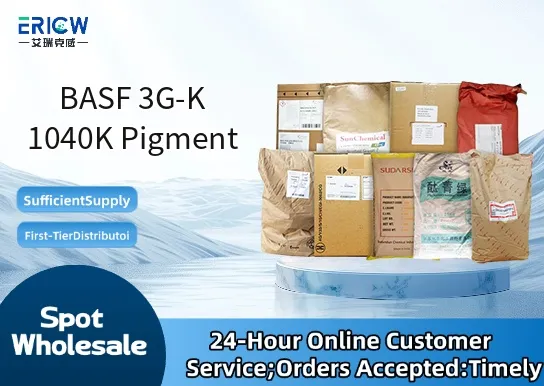
Q1: What is the primary chemical nature and classification of BASF 3G-K 1040K Pigment?
A: BASF 3G-K 1040K is a high-performance organic pigment dispersion, formulated as a liquid concentrate based on a copper phthalocyanine derivative. It is classified as a solvent-free, aqueous-based pigment preparation designed for compatibility with waterborne systems.
Q2: Is this pigment suitable for use in food-contact or pharmaceutical packaging inks?
A: BASF 3G-K 1040K is not pre-qualified for direct food-contact applications. Its suitability for such uses depends on full regulatory assessment by the end-formulator, including migration testing and compliance verification against applicable regional requirements for intended substrate and processing conditions.
Q3: How should BASF 3G-K 1040K be incorporated into water-based coatings or inks?
A: It is recommended to add the pigment dispersion under moderate agitation during the let-down stage, after base resin and additives have been dispersed. Avoid high-shear mixing post-addition to prevent destabilization. Compatibility and stability should be verified in the final formulation through standard shelf-life and filtration tests.
Q4: What are typical dosage levels when using this pigment in industrial waterborne coatings?
A: Dosage depends on the required color strength and opacity, but it is typically used at low concentrations—generally ranging from 0.1% to 2% by weight relative to total formulation solids—to achieve strong blue-green shades with excellent tinctorial strength and lightfastness.
Contact With Us:
E-mail: wangxingqiang@ericwchem.com
Have a Questions? Call Us:
Add:
Building A1, Jiete Industrial Park, Huangpu District, Guangzhou City, Guangdong Province, China