English
 Español
 tiếng việt
 русский
Excellent clarity and high-gloss surface finish for premium optical performance.
Good melt flow characteristics enabling efficient processing via extrusion and injection molding.
Outstanding weather resistance and UV stability without requiring additional stabilizers.
High impact strength combined with dimensional stability across a broad temperature range.
Low moisture absorption ensuring consistent mechanical properties in humid environments.
Automotive interior trim components including instrument panels and bezels.
LED light guides and diffuser plates for general lighting and display backlighting.
Transparent protective covers for industrial control interfaces and HMI devices.
Medical device housings requiring optical clarity, sterilizability, and chemical resistance.
Consumer electronics enclosures for wearables and portable diagnostic equipment.
| Chemical Type | Polymethyl methacrylate (PMMA) homopolymer |
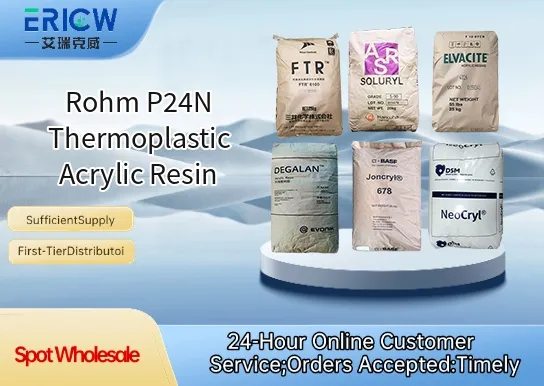
| Product Form | Pellets |
| Appearance | Translucent, free-flowing granules |
| Melt Flow Rate (230 °C / 3.8 kg) | 12–16 g/10 min |
| Density (23 °C) | 1.18–1.20 g/cm³ |
| Water Absorption (24 h, 23 °C) | 0.3–0.4 wt% |
| Heat Deflection Temperature (1.82 MPa) | 105–108 °C |
| Primary Applications | Optical parts, transparent structural components, precision molded articles |
Q1: What is the primary function of Rohm P24N in thermoplastic formulations?
A: Rohm P24N is a thermoplastic acrylic resin designed primarily as a rheology modifier and processing aid. It enhances melt flow behavior, improves surface gloss, and contributes to better pigment dispersion and substrate wetting in thermoplastic systems such as ABS, PS, and PC blends.
Q2: Is Rohm P24N suitable for use in food-contact or medical-grade applications?
A: Rohm P24N is not pre-qualified for direct food-contact or medical device applications. Its suitability for such uses depends on full regulatory assessment by the formulator, including compatibility with applicable regional requirements and final product testing. Customers must conduct their own due diligence and validation.
Q3: How is Rohm P24N typically incorporated into thermoplastic compounds?
A: Rohm P24N is generally introduced during compounding—either via side-feeding into an extruder or dry-blended with base polymer prior to melt processing. It exhibits good thermal stability under standard extrusion and injection molding conditions, and does not require pre-drying under typical handling practices.
Q4: Does Rohm P24N affect the mechanical properties of the final part?
A: At recommended usage levels, Rohm P24N has minimal impact on tensile strength or impact resistance. Its main influence is on surface-related properties and processability. Significant deviations from typical dosage ranges may alter stiffness or ductility, so optimization is advised for each specific formulation.
Contact With Us:
E-mail: wangxingqiang@ericwchem.com
Have a Questions? Call Us:
Add:
Building A1, Jiete Industrial Park, Huangpu District, Guangzhou City, Guangdong Province, China