English
 Español
 tiếng việt
 русский
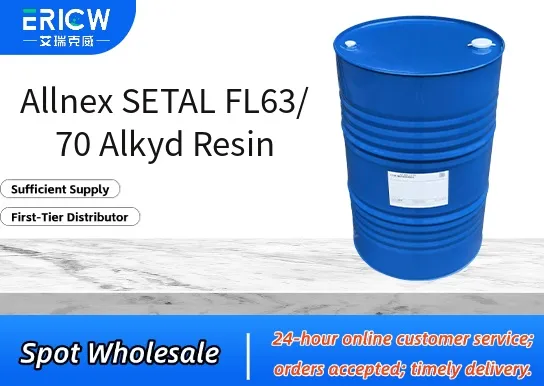
Medium-oil-length alkyd resin offering balanced drying speed and film hardness.
Excellent compatibility with nitrocellulose, acrylics, and other common coating resins.
Provides good gloss retention and long-term weather resistance in exterior applications.
Low-viscosity liquid form enables easy formulation and high-solids blending without excessive thinning.
Designed for solvent-borne industrial coatings requiring robust mechanical and chemical resistance.
Industrial maintenance coatings for metal structures and equipment.
General-purpose air-drying enamels for metal furniture and fixtures.
Undercoats and primers for automotive refinish and agricultural machinery.
Marine topcoats where moderate corrosion protection and UV stability are required.
Decorative architectural coatings for metal cladding and façade systems.
| Chemical Type | Medium-oil modified alkyd resin |
| Product Form | Liquid |
| Appearance | Clear to slightly yellow viscous liquid |
| Solvent | Xylene / mineral spirits (standard grade) |
| Non-Volatile Content | ~65–70 wt% (as supplied) |
| Acid Value | 6–10 mg KOH/g |
| Viscosity (25°C) | 80–120 mPa·s (Brookfield RV, spindle #3, 20 rpm) |
| Primary Applications | Industrial maintenance, general-purpose enamels, marine & architectural topcoats |
Q1: What is the primary function of SETAL FL63/70 in coating formulations?
A: SETAL FL63/70 is a low-viscosity, solvent-borne alkyd resin designed to act as a reactive diluent and film-forming binder. It enhances flow, leveling, and gloss development while contributing to good through-dry and substrate adhesion in decorative and protective coatings.
Q2: Is SETAL FL63/70 compatible with common crosslinkers used in industrial baking systems?
A: Yes — it is formulated for compatibility with melamine-formaldehyde resins and other amino crosslinkers typically employed in stoving enamels. Its functionality and acid value support efficient co-reactivity under standard curing conditions without significant gelation risk.
Q3: Can SETAL FL63/70 be used in water-reducible or high-solids systems?
A: While inherently solvent-based, SETAL FL63/70 can be incorporated into water-reducible alkyd emulsions or high-solids formulations when properly balanced with surfactants or reactive diluents. Performance optimization requires formulation testing to ensure stability and film integrity.
Q4: How does SETAL FL63/70 compare to conventional long-oil alkyds in terms of drying behavior?
A: Due to its medium-oil length and tailored fatty acid profile, SETAL FL63/70 offers faster air-dry surface formation and improved through-dry versus traditional long-oil alkyds — making it suitable for applications where handling time and production throughput are critical.
Contact With Us:
E-mail: wangxingqiang@ericwchem.com
Have a Questions? Call Us:
Add:
Building A1, Jiete Industrial Park, Huangpu District, Guangzhou City, Guangdong Province, China