English
 Español
 tiếng việt
 русский
Highly selective for ketone hydrogenation and reductive amination reactions.
Thermally stable under industrial process conditions up to 120 °C.
Low metal leaching ensures product purity and extended catalyst lifetime.
Available in multiple supported nickel formulations tailored for batch and continuous flow reactors.
Consistent performance across lot-to-lot manufacturing with strict QC certification.
Pharmaceutical intermediate synthesis, including chiral amine production.
Fine chemical manufacturing of specialty amines and amino alcohols.
Agrochemical active ingredient synthesis requiring high chemoselectivity.
Flavor and fragrance compound hydrogenation with minimal over-reduction.
| Chemical Type | Nickel-based heterogeneous catalyst |
| Product Form | Pelleted or extrudate solid |
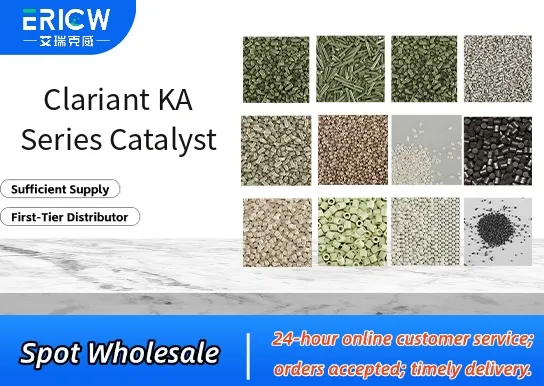
| Appearance | Gray-black cylindrical pellets |
| Primary Applications | Ketone hydrogenation, reductive amination, nitro-group reduction |
| Key Features | High activity, excellent selectivity, low sulfur sensitivity |
| Benefits | Reduced processing time, lower catalyst loading, simplified downstream purification |
| Storage Condition | Under inert atmosphere (N₂ or Ar), dry and cool environment |
Q1: What types of polymerization reactions is the KA Series primarily designed for?
A: The Clariant KA Series Catalysts are specifically engineered for condensation polymerizations, particularly in the production of polyesters and polyamide precursors, where controlled reaction kinetics and high selectivity are essential.
Q2: How does the KA Series differ from conventional antimony-based catalysts in terms of performance and safety profile?
A: Unlike traditional antimony catalysts, the KA Series offers a non-antimony, heavy-metal-free alternative with comparable catalytic efficiency, improved thermal stability during processing, and reduced concerns regarding regulatory scrutiny and end-product migration potential.
Q3: What is the typical dosage range for KA Series catalysts in polyester melt-phase processes?
A: Dosage is formulation- and process-dependent, but the KA Series is generally used at low concentrations—typically ranging from 0.1% to 2% by weight relative to the total monomer charge—to achieve optimal activity without compromising polymer clarity or thermal stability.
Q4: Is pre-treatment or activation required before introducing the KA Series into the polymerization reactor?
A: No pre-activation is necessary—the KA Series catalysts are supplied as stable, ready-to-use solids or solutions compatible with standard charging systems, and they begin exerting catalytic effect upon dissolution/melting into the reaction medium under typical process conditions.
Contact With Us:
E-mail: wangxingqiang@ericwchem.com
Have a Questions? Call Us:
Add:
Building A1, Jiete Industrial Park, Huangpu District, Guangzhou City, Guangdong Province, China