English
 Español
 tiếng việt
 русский
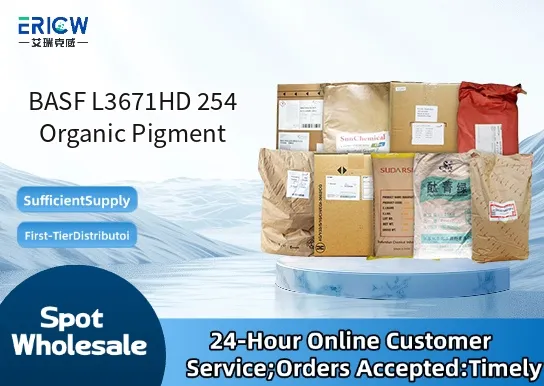
High chroma and excellent lightfastness for long-term color stability in demanding applications.
Outstanding heat stability up to 280 °C, suitable for high-temperature polymer processing.
Good dispersibility in both polar and non-polar media, enabling efficient incorporation into various resin systems.
Low volatility and minimal extractables, meeting stringent regulatory requirements for food-contact and automotive interior applications.
Consistent batch-to-batch color reproducibility supported by BASF’s certified quality control system.
Automotive interior plastics (e.g., dashboards, door panels, trim components).
Engineering thermoplastics including polypropylene (PP), polyethylene (PE), and ABS.
Masterbatch formulations for color concentrate production.
Consumer electronics housings requiring high-gloss, fade-resistant finishes.
| Chemical Type | Benzimidazolone pigment |
| Product Form | Free-flowing powder |
| Appearance | Reddish orange powder |
| Primary Applications | Plastics, masterbatches, engineering polymers |
| Key Features | Heat stable, lightfast, low migration |
| Benefits | Color consistency, process robustness, regulatory compliance (EU REACH, FDA-compliant for indirect food contact) |
| Particle Size (D50) | 0.12–0.18 µm (by laser diffraction) |
| Volatility (Loss on drying at 130 °C) | < 1.0 wt% |
Q1: What are the primary application areas for BASF L3671HD 254?
A: BASF L3671HD 254 is a high-performance organic pigment specifically engineered for demanding industrial coating systems, including automotive OEM and refinish coatings, high-gloss architectural paints, and premium plastic coloration—particularly where excellent lightfastness, thermal stability, and clean blue-shade red hue are required.
Q2: Is L3671HD 254 suitable for use in food-contact plastics or inks?
A: No—L3671HD 254 is not certified for direct food-contact applications. It is formulated for non-food industrial uses and does not meet regulatory requirements for migration-sensitive applications such as packaging inks or polymer matrices intended for food contact.
Q3: How does L3671HD 254 compare to conventional quinacridone pigments in terms of dispersion stability?
A: L3671HD 254 features optimized surface treatment for enhanced wetting and reduced agglomeration in both solvent-borne and water-borne systems. Compared to standard quinacridone grades, it demonstrates improved dispersion stability under high-shear processing and better resistance to flocculation during storage.
Q4: What is the recommended dosage range in thermoplastic polymers?
A: Dosage depends on the polymer matrix, desired chroma, and processing conditions—but L3671HD 254 is typically used at low concentrations due to its high tinctorial strength. In polyolefins and engineering thermoplastics, effective loading generally ranges from 0.1% to 2% by weight.
Contact With Us:
E-mail: wangxingqiang@ericwchem.com
Have a Questions? Call Us:
Add:
Building A1, Jiete Industrial Park, Huangpu District, Guangzhou City, Guangdong Province, China