English
 Español
 tiếng việt
 русский
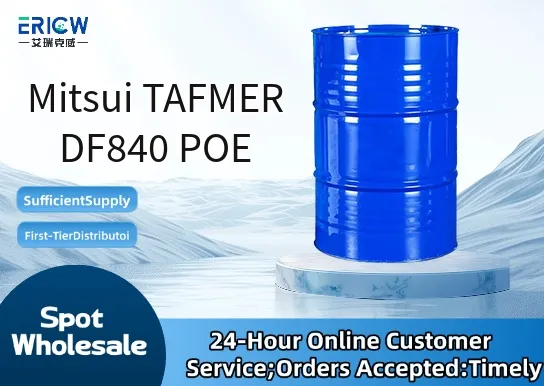
Excellent melt flowability for high-speed extrusion and injection molding processes.
Superior flexibility and low-temperature impact resistance down to –40 °C.
Outstanding compatibility with polypropylene (PP) and polyethylene (PE) for blend modification.
Low density (≈0.870 g/cm³) enabling lightweight, high-volume parts without sacrificing toughness.
Good processability on conventional thermoplastic equipment without requiring special drying or handling.
Automotive interior trim components including door panels and instrument bezels.
Flexible packaging films requiring seal integrity and puncture resistance.
Toughened polypropylene (PP) compounds for under-hood automotive parts.
Soft-touch overmolding for consumer electronics and appliance housings.
Medical tubing and connectors requiring biocompatibility support and kink resistance.
| Chemical Type | Ethylene-octene copolymer (POE) |
| Product Form | Pellets |
| Appearance | Off-white, free-flowing pellets |
| Density (ASTM D792) | 0.870 g/cm³ |
| Melt Flow Rate (190 °C/2.16 kg, ASTM D1238) | 2.5 g/10 min |
| Flexural Modulus (ASTM D790) | 15 MPa |
| Notched Izod Impact (23 °C, ASTM D256) | 350 J/m |
| Primary Applications | PP/PE toughening, soft-touch overmolding, flexible packaging |
Q1: What is the primary function of TAFMER DF840 in polymer blends?
A: TAFMER DF840 is an ethylene-octene copolymer designed primarily as a compatibilizer and impact modifier—especially effective in polypropylene (PP) and polyethylene (PE) based systems where improved toughness, flexibility, and interfacial adhesion are required.
Q2: Is TAFMER DF840 suitable for use in food-contact applications?
A: TAFMER DF840 is manufactured to meet stringent purity standards and is commonly selected for food-contact compliant formulations when incorporated into finished articles that comply with relevant regional regulatory frameworks—final approval depends on the full formulation and end-use conditions.
Q3: How does DF840 compare to other TAFMER grades in terms of melt flow and flexibility?
A: DF840 features a relatively low melt flow index and higher octene content compared to many standard TAFMER PEs, resulting in enhanced elasticity and lower hardness—making it especially suited for soft-touch overmolding and flexible PP modification where balance between processability and performance is critical.
Q4: Can DF840 be used in injection molding processes?
A: Yes—DF840 is widely processed via injection molding, extrusion, and blow molding. Its thermal stability and consistent rheology support robust processing across conventional equipment, though optimal parameters should be validated for each specific compound and part geometry.
Contact With Us:
E-mail: wangxingqiang@ericwchem.com
Have a Questions? Call Us:
Add:
Building A1, Jiete Industrial Park, Huangpu District, Guangzhou City, Guangdong Province, China