English
 Español
 tiếng việt
 русский
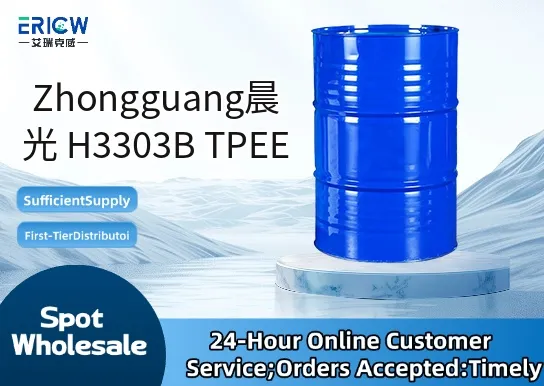
Excellent balance of thermoplastic processability and elastomeric performance.
High tensile strength and outstanding resilience at elevated temperatures.
Good resistance to oils, greases, and common industrial chemicals.
Low compression set for long-term sealing and dynamic part reliability.
Compatible with injection molding, extrusion, and blow molding processes.
Automotive under-hood components including air ducts and sensor housings.
Industrial hoses and fluid transfer tubing requiring fatigue resistance.
Consumer electronics protective casings and flexible connectors.
Medical device tubing and non-implantable elastomeric parts.
High-performance sporting goods components such as ski bindings and gear housings.
| Chemical Type | Thermoplastic Polyester Elastomer (TPEE) |
| Product Form | Pellets |
| Appearance | Off-white to light amber, free-flowing granules |
| Primary Applications | Dynamic mechanical parts, seals, flexible structural components |
| Key Features | Heat resistance up to 150°C short-term, high flex life, low creep |
| Benefits | Reduced part weight vs. thermoset rubber; recyclable and reprocessable |
| Processing Method | Injection molding, extrusion, blow molding |
| Standards Compliance | RoHS compliant; meets ISO 10993-5 for cytotoxicity (non-implantable use) |
Q1: What are the key processing advantages of Zhongguang H3303B TPEE compared to conventional thermoplastic elastomers?
A: Zhongguang H3303B TPEE offers excellent melt stability and low viscosity at processing temperatures, enabling smooth extrusion and injection molding without significant thermal degradation. Its fast crystallization kinetics support shorter cycle times and improved dimensional stability in thin-walled parts.
Q2: Is H3303B suitable for applications requiring resistance to oils, greases, and aliphatic hydrocarbons?
A: Yes — as a polyester-based TPEE, H3303B demonstrates inherently superior resistance to non-polar media such as oils, greases, and aliphatic hydrocarbons compared to many TPU or TPO grades, making it well-suited for under-hood automotive components and industrial seals.
Q3: Can H3303B be blended with other polymers, and what compatibility considerations apply?
A: H3303B is commonly blended with polyesters (e.g., PET, PBT) and certain engineering thermoplastics to tailor stiffness, impact performance, or thermal behavior. For optimal compatibility, avoid pairing with highly polar or acidic resins unless validated through melt rheology and morphology testing.
Q4: How does moisture sensitivity affect the handling and drying requirements for H3303B before processing?
A: Like most polyester elastomers, H3303B is hygroscopic and requires thorough drying prior to melt processing. Standard practice is to dry at 100–120 °C for 2–4 hours using desiccant-equipped equipment to minimize hydrolysis risk and maintain mechanical integrity.
Contact With Us:
E-mail: wangxingqiang@ericwchem.com
Have a Questions? Call Us:
Add:
Building A1, Jiete Industrial Park, Huangpu District, Guangzhou City, Guangdong Province, China