English
 Español
 tiếng việt
 русский
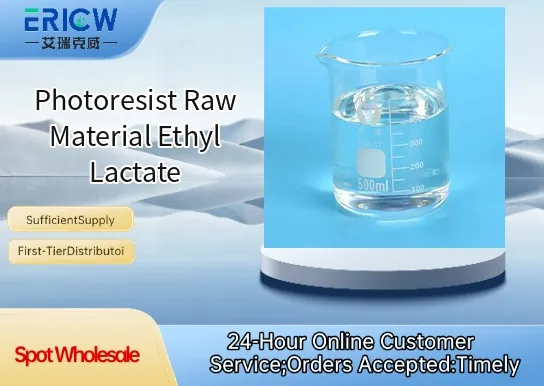
High-purity solvent with ≥99.5% assay, specifically refined for photoresist formulation to minimize particulate and ionic contamination.
Low volatility and favorable evaporation profile—enables uniform film formation and controlled drying during spin-coating processes.
Excellent solvency for common photoacid generators (PAGs), resins (e.g., novolac, PHS, acrylate-based), and additives without premature precipitation.
Biodegradable and low-toxicity ester derived from renewable lactic acid—supports green manufacturing initiatives and safer workplace handling.
Consistent batch-to-batch performance validated via GC, Karl Fischer titration, and trace metal analysis (ICP-MS).
Primary solvent in positive-tone and chemically amplified photoresists for semiconductor lithography (i-line, KrF, and ArF immersion).
Co-solvent in OLED display photoresist formulations to improve coating uniformity and edge definition on flexible substrates.
Carrier medium for photoresist rework and stripping solutions requiring selective solubility and low residue.
Process aid in microelectromechanical systems (MEMS) patterning where low surface tension and high compatibility with silicon dioxide are critical.
Environmental replacement for ethyl acetate or PGMEA in eco-sensitive photolithography lines seeking VOC-reduced processing.
| Chemical Type | Organic ester (ethyl 2-hydroxypropanoate) |
| Product Form | Clear, colorless liquid |
| Appearance | Transparent, free from suspended matter and cloudiness |
| Melting Point | −25 °C (typical) |
| Boiling Point (760 mmHg) | 154–158 °C |
| Water Content (KF) | ≤0.05 wt% |
| Residue on Evaporation | ≤10 ppm |
| Key Regulatory Compliance | REACH registered; non-REACH SVHC; compliant with SEMI S2-0215 EHS guidelines |
| Common Compatible Systems | Suitability |
| Novolac-based i-line photoresists (e.g., AZ® series) | Highly Recommended – Proven compatibility with resin dissolution kinetics and thermal stability |
| Chemically amplified KrF resists (e.g., JSR APEX-E derivatives) | Recommended – Requires minor formulation adjustment for optimal PAG dispersion |
| Acrylate-based EUV resist platforms | Suitable – Demonstrated efficacy as co-solvent with PGMEA; supports low-outgassing requirements |
| Photoresist removers (e.g., NMD-3 analogues) | Highly Recommended – Enhances swelling and lift-off without substrate attack on SiN or low-k dielectrics |
Q1: What is the CAS number for Ethyl Lactate used in photoresist applications?
A: The CAS Registry Number is 97-64-3. Our photoresist-grade material meets ASTM D7262 purity specifications and is certified for semiconductor use.
Q2: What is the typical recommended usage concentration in photoresist formulations?
A: Standard loading ranges from 70–90 wt% of total solvent blend, often combined with PGMEA or propylene glycol monomethyl ether to fine-tune evaporation rate and film quality.
Q3: How does Ethyl Lactate compare to PGMEA in terms of environmental impact and process safety?
A: Ethyl Lactate has lower acute toxicity (LD50 oral rat = 4,400 mg/kg vs. PGMEA’s 2,400 mg/kg), higher biodegradability (>90% in 28 days, OECD 301B), and is not classified as a VOC under U.S. EPA Method 24, supporting cleaner air permit compliance.
Q4: Is there risk of lactide or lactic acid migration into the resist film during storage or baking?
A: No—our stabilized grade includes proprietary hydrolysis inhibitors and undergoes accelerated aging testing (40 °C/75% RH for 90 days) with no detectable degradation (<0.1% lactide formation by GC-MS).
Contact With Us:
E-mail: wangxingqiang@ericwchem.com
Have a Questions? Call Us:
Add:
Building A1, Jiete Industrial Park, Huangpu District, Guangzhou City, Guangdong Province, China