English
 Español
 tiếng việt
 русский
Broad-spectrum fungicidal activity against key foliar and soil-borne pathogens including Rhizoctonia, Fusarium, and Pythium species.
Systemic and protective action provides both curative and preventative disease control.
Optimized for compatibility with common agricultural adjuvants and tank-mix partners in integrated pest management programs.
Low volatility and favorable environmental profile support sustainable use under modern regulatory frameworks.
Stable formulation ensures consistent field performance across varying temperature and humidity conditions.
Rice cultivation for control of sheath blight and seedling damping-off.
Soybean production targeting root rot and foliar blight diseases.
Corn (maize) fields to manage southern rust and gray leaf spot.
Horticultural crops including tomato and cucumber in greenhouse and open-field systems.
Seed treatment applications for enhanced early-season disease protection.
| Chemical Type | Triazole-class systemic fungicide (active ingredient: tebuconazole) |
| Product Form | Flowable suspension concentrate (FS) |
| Appearance | Off-white to light beige suspension |
| Active Ingredient Concentration | 300 g/L tebuconazole |
| Primary Applications | Foliar spray, seed treatment, soil drench |
| Key Features | Systemic translocation, rainfastness >4 hours, UV-stabilized formulation |
| Storage Stability | 24 months at 5–30 °C in original unopened container |
| Compatibility | Compatible with most organophosphates, carbamates, and neonicotinoids (compatibility testing recommended prior to tank mixing) |
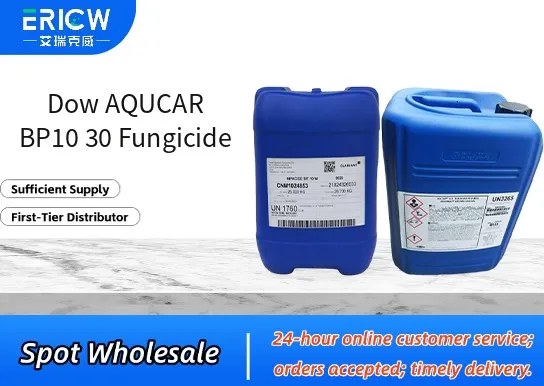
Q1: What is the primary mode of action of Dow AQUCAR BP10 30 Fungicide?
A: Dow AQUCAR BP10 30 Fungicide functions as a broad-spectrum, contact-protective fungicide. It inhibits fungal spore germination and mycelial growth on surfaces by disrupting key cellular processes, providing effective control against common molds and yeasts in industrial water systems and coatings.
Q2: In which types of formulations is Dow AQUCAR BP10 30 typically incorporated?
A: This product is commonly used in water-based industrial coatings, adhesives, sealants, construction mortars, and polymer dispersions where long-term resistance to microbial degradation is required. Its compatibility with polar media and stability across a moderate pH range supports integration into diverse aqueous systems.
Q3: How should Dow AQUCAR BP10 30 be dosed in finished products?
A: Dosage depends on formulation requirements, environmental conditions, and target microorganisms. It is typically used at low concentrations—generally ranging from 0.1% to 2% by weight of the final product—and should be optimized through laboratory challenge testing under representative use conditions.
Q4: Is Dow AQUCAR BP10 30 compatible with common co-biocides or preservatives?
A: Yes, it demonstrates good compatibility with several widely used isothiazolinones, benzisothiazolinones, and formaldehyde-releasers in aqueous systems. However, synergistic or antagonistic interactions may occur depending on pH, ionic strength, and specific actives; compatibility testing is recommended prior to full-scale formulation.
Contact With Us:
E-mail: wangxingqiang@ericwchem.com
Have a Questions? Call Us:
Add:
Building A1, Jiete Industrial Park, Huangpu District, Guangzhou City, Guangdong Province, China