English
 Español
 tiếng việt
 русский
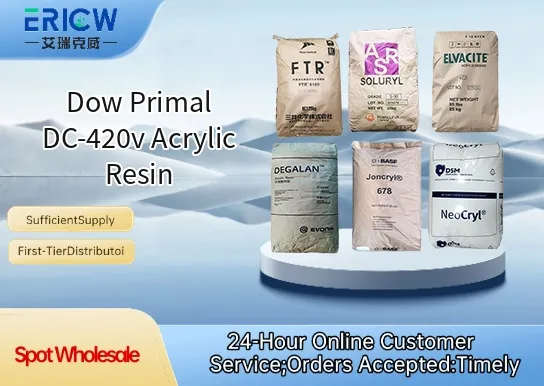
High-solids, low-VOC acrylic emulsion designed for demanding industrial coatings.
Excellent pigment wetting and dispersion stability in waterborne systems.
Superior film formation at ambient temperatures with low minimum film formation temperature (MFFT).
Good alkali resistance and hydrolytic stability for long-term formulation integrity.
Compatible with common coalescents, rheology modifiers, and crosslinkers used in architectural and industrial coatings.
Interior and exterior architectural wall paints requiring scrub resistance and color retention.
Industrial maintenance coatings for metal substrates in mild-to-moderate exposure environments.
Waterborne wood stains and clear finishes where clarity and adhesion are critical.
Primer formulations for masonry, drywall, and plaster surfaces.
Decorative concrete sealers and overlays for commercial flooring applications.
| Chemical Type | Acrylic copolymer emulsion |
| Product Form | White to off-white liquid |
| Appearance | Opaque, homogeneous liquid |
| Solids Content (wt%) | 42.0 ± 1.0% |
| pH (at 25°C) | 8.0 – 9.0 |
| Viscosity (Brookfield, #2 spindle, 20 rpm, 25°C) | 50 – 200 mPa·s |
| Minimum Film Formation Temperature (MFFT) | ≈ 12°C |
| Primary Applications | Architectural and industrial waterborne coatings |
Q1: What is the primary function of Dow Primal DC-420v in water-based coatings and inks?
A: Dow Primal DC-420v is a hydrophobically modified acrylic associative thickener designed to provide rheology control—specifically, high-shear viscosity stabilization and improved sag resistance—without significantly increasing low-shear viscosity. It helps maintain formulation stability and enhances application performance in architectural paints, industrial coatings, and pigment-dispersed systems.
Q2: How does Dow Primal DC-420v differ from non-associative thickeners like CMC or HEC?
A: Unlike cellulosic or non-associative synthetic thickeners, DC-420v functions through transient hydrophobic associations between polymer chains and surfactants or other hydrophobic domains in the formulation. This mechanism delivers superior shear-thinning behavior, better spatter resistance, and improved leveling—while minimizing sensitivity to electrolytes and pH shifts common in complex water-based systems.
Q3: Is Dow Primal DC-420v compatible with biocides and common co-thickeners?
A: Yes, DC-420v generally exhibits good compatibility with isothiazolinone- and benzisothiazole-based biocides, as well as with other rheology modifiers such as hydrophobically modified ethoxylated urethanes (HEURs) or fumed silica. However, optimal synergy and stability should be verified experimentally, as interactions may vary depending on formulation pH, ionic strength, and surfactant profile.
Q4: What is the recommended addition method for Dow Primal DC-420v in paint formulations?
A: DC-420v is typically added during the let-down stage, after pigments and primary thickeners are dispersed. It should be diluted with water or a compatible solvent prior to incorporation and mixed under moderate agitation to ensure uniform distribution. Avoid high-shear dispersion during addition to prevent premature association or gel formation.
Contact With Us:
E-mail: wangxingqiang@ericwchem.com
Have a Questions? Call Us:
Add:
Building A1, Jiete Industrial Park, Huangpu District, Guangzhou City, Guangdong Province, China