English
 Español
 tiếng việt
 русский
Highly selective for divalent cations such as Ca²⁺ and Mg²⁺ in softening applications.
Exceptional chemical stability in acidic and alkaline environments up to pH 1–14.
Optimized bead uniformity and mechanical strength for low pressure drop and extended service life.
Low soluble organic carbon (SOC) release, ensuring compliance with stringent water quality standards.
Regenerable with common NaCl brine, enabling cost-effective and sustainable operation.
Drinking water softening in municipal and point-of-entry systems.
Pretreatment for reverse osmosis (RO) and boiler feedwater systems.
Food and beverage processing where consistent ion removal is critical.
Pharmaceutical-grade water purification meeting USP/EP requirements.
Industrial process water conditioning for textile, dyeing, and electroplating operations.
| Chemical Type | Strong acid cation exchange resin (sulfonated polystyrene-divinylbenzene) |
| Product Form | Moist, spherical beads |
| Appearance | Amber, translucent, uniform spheres |
| Functional Group | Sulfonic acid (–SO₃H) |
| Ion Form | Na⁺ form (ready-to-use) |
| Particle Size Range | 0.315–1.25 mm |
| Moisture Content | 47–52 % (w/w) |
| Exchange Capacity (min) | 1.8 mmol/mL (Na⁺ form) |
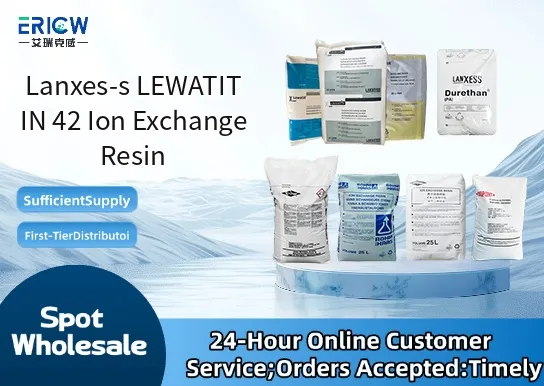
Q1: What is the primary functional group and ionic form of LANXESS LEWATIT IN 42?
A: LEWATIT IN 42 is a strongly acidic cation exchange resin based on a styrene-divinylbenzene matrix, functionalized with sulfonic acid groups. It is supplied in the sodium (Na⁺) form, making it suitable for softening and selective cation removal applications.
Q2: Is LEWATIT IN 42 suitable for food-grade or pharmaceutical water treatment?
A: Yes — LEWATIT IN 42 is manufactured and tested to meet requirements for use in the production of potable water and purified water in food and pharmaceutical applications, provided it is operated within validated process parameters and regenerated according to regulatory expectations for ion exchange resins.
Q3: How does LEWATIT IN 42 compare to gel-type resins in terms of kinetics and capacity under varying water quality conditions?
A: As a macroporous resin, LEWATIT IN 42 offers improved mass transfer kinetics and greater resistance to fouling from organic matter or suspended solids compared to conventional gel-type cation exchangers. Its physical structure supports consistent performance in waters with moderate turbidity or higher organic load, though pretreatment is still recommended for optimal service life.
Q4: What regeneration chemicals and typical regenerant concentrations are used with LEWATIT IN 42?
A: Sodium chloride (NaCl) is the standard regenerant for softening operation. Regeneration efficiency is optimized using common industrial brine solutions, typically at concentrations between 8% and 12% w/w NaCl. Acid-based regeneration (e.g., HCl or H₂SO₄) may be applied for full hydrogen-form conversion when required for demineralization duty.
Contact With Us:
E-mail: wangxingqiang@ericwchem.com
Have a Questions? Call Us:
Add:
Building A1, Jiete Industrial Park, Huangpu District, Guangzhou City, Guangdong Province, China