English
 Español
 tiếng việt
 русский
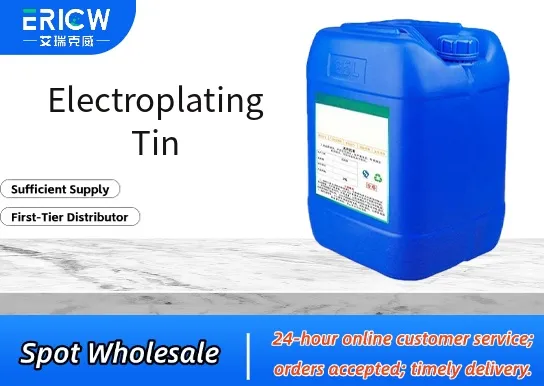
High-purity metallic tin deposit with excellent solderability and wire bondability.
Uniform, low-stress coating providing superior corrosion resistance in mild environments.
Lead-free formulation compliant with RoHS 2015/863 and REACH SVHC regulations.
Consistent bath stability and high current efficiency (>90%) across standard operating ranges.
Minimal hydrogen embrittlement risk—suitable for high-strength steel substrates.
Electrical connectors and contact springs in automotive and industrial electronics.
Leadframes and IC packaging components requiring reliable solder wetting.
Food-grade container closures (e.g., can ends and lids) meeting FDA 21 CFR §175.300 requirements.
Printed circuit board (PCB) edge connectors and surface finishes prior to solder masking.
Fasteners and precision machined parts requiring non-galling, conductive, and non-magnetic properties.
| Chemical Type | Metallic tin (Sn⁰) from acidic methanesulfonic acid (MSA)-based electrolyte |
| Product Form | Concentrated liquid plating solution (ready-to-dilute) |
| Appearance | Clear, colorless to pale yellow liquid |
| pH Range (as supplied) | 0.8 – 1.4 |
| Operating Temperature | 15 – 30 °C |
| Primary Applications | Functional and decorative electroplating on copper, brass, steel, and nickel substrates |
| Key Features | Self-leveling deposit, bright-to-satin finish options, no cyanide or phenol |
| Regulatory Compliance | RoHS 2015/863, REACH Annex XVII, FDA 21 CFR §175.300 (for food-contact applications) |
| Common Compatible Systems | Suitability |
| MSA-based tin plating systems (e.g., Atotech TinPlus®, MacDermid Enthone TinSEAL®) | Highly Recommended – Designed for seamless integration and optimized deposit performance |
| Acid copper pre-plating baths (sulfuric acid + chloride) | Recommended – Requires thorough rinse; no adverse interaction observed |
| Alkaline cleaning and acid activation (e.g., HCl or H₂SO₄ pickling) | Highly Recommended – Standard pretreatment sequence with proven adhesion |
| Post-plating chromate passivation (trivalent Cr) and hot DI water sealing | Recommended – Enhances tarnish resistance without compromising solderability |
Q1: What is the CAS Registry Number for Electroplating Tin metal deposit and its primary electrolyte?
A: The deposited tin metal has CAS No. 7440-31-5. The MSA-based electrolyte contains methanesulfonic acid (CAS 75-75-2) and stannous methanesulfonate (CAS 14227-12-4), with full composition disclosed under NDA upon request.
Q2: What is the typical tin deposit thickness range recommended for electronic component applications?
A: For solderable electronic contacts, 3–8 µm is standard; for food-can applications, 5–15 g/m² (≈0.5–1.5 µm) meets global regulatory migration limits (EU 10/2011, FDA).
Q3: How does Electroplating Tin compare to electroless tin and hot-dip tin in terms of dimensional control and purity?
A: Electroplated tin offers superior thickness uniformity (<±5% variation), lower carbon/oxygen contamination vs. electroless tin, and avoids zinc/iron alloying layers inherent to hot-dip processes—critical for fine-pitch SMT reliability.
Q4: Is tin migration or whisker growth a concern, and how is it mitigated?
A: Whisker risk is minimized through compressive stress control, post-plate reflow (optional), and compliance with JEDEC JESD22-A121 for pure Sn deposits; no brighteners or organic additives that promote whiskering are used.
Q5: Does the product meet EU food contact material (FCM) compliance for tin migration testing?
A: Yes—validated per EU Regulation (EC) No. 10/2011: migration of Sn ≤ 200 mg/kg in 3% acetic acid at 40°C for 10 days; certified test reports available upon qualification.
Contact With Us:
E-mail: wangxingqiang@ericwchem.com
Have a Questions? Call Us:
Add:
Building A1, Jiete Industrial Park, Huangpu District, Guangzhou City, Guangdong Province, China