English
 Español
 tiếng việt
 русский
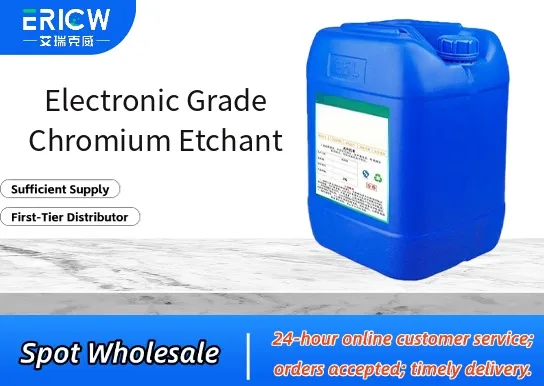
Ultra-low metallic impurity levels (<1 ppb for Na, K, Fe, Ni, Cu), ensuring minimal contamination in sensitive microelectronic fabrication.
Controlled etch rate uniformity (±3% across 200 mm wafers) enabled by rigorous lot-to-lot consistency and ISO 9001-certified manufacturing.
Non-aqueous, anhydrous formulation minimizes hydrogen evolution and interfacial oxidation during Cr layer removal.
Stable shelf life of ≥12 months when stored at 15–25°C under inert atmosphere (N₂ blanket).
Compatible with automated wet bench dispensing systems and supports closed-loop recirculation without precipitation or clogging.
Patterned chromium mask removal in photomask reticle cleaning and repair processes.
Back-end-of-line (BEOL) chromium hard mask stripping in advanced logic and memory device fabrication (≤28 nm nodes).
Surface conditioning of Cr-coated quartz substrates prior to thin-film deposition in optical MEMS and RF filter manufacturing.
Defect-free etching of Cr adhesion layers beneath Au/Ti/Cr stacks in high-frequency packaging substrates.
Residue-free removal of sputtered chromium films from SiC and GaN power device wafers.
| Chemical Type | Cerium(IV) ammonium nitrate (CAN)-based oxidizing etchant with proprietary stabilizers |
| Product Form | Liquid concentrate (ready-to-use; no dilution required) |
| Appearance | Clear, pale amber solution; free of particulates and haze |
| Primary Applications | Etching of metallic chromium (Cr⁰) and chromium oxide (Cr₂O₃) thin films (5–500 nm thickness) |
| Key Features | pH-stabilized (pH 3.8–4.2), non-hydrofluoric, low vapor pressure, non-volatile residue |
| Benefits | Eliminates need for post-etch RCA clean; reduces particle adders by >90% vs. traditional acid mixtures |
| Regulatory Compliance | REACH SVHC-free; RoHS 2015/863 compliant; TSCA listed (CAS 16774-82-2 for CAN base) |
| Storage Requirements | 15–25°C, dry, dark, N₂-purged container; avoid contact with moisture or reducing agents |
| Common Compatible Systems | Suitability |
| SEMI-standard single-wafer spin-rinse-dry (SRD) tools | Highly Recommended – Fully validated for ≤300 mm wafer processing with <0.5 nm surface roughness retention |
| Benchtop immersion tanks with PFA-lined chambers | Recommended – Requires temperature control (20 ± 1°C) and agitation for optimal uniformity |
| Cluster tools with integrated wet modules (e.g., Tokyo Electron UF3000) | Suitable – Compatible with standard fluidic interfaces; verify seal material compatibility (FFKM recommended) |
| Automated mask cleaning platforms (e.g., Dainippon Screen MZ series) | Highly Recommended – Pre-qualified for photomask Cr etch cycles with zero chrome redeposition |
Q1: What is the CAS Registry Number for this etchant?
A: The primary active component, cerium(IV) ammonium nitrate, carries CAS No. 16774-82-2. Full product formulation is proprietary and assigned internal batch-specific registration per ICH Q5E guidelines.
Q2: What is the recommended etch rate and process window for 100 nm Cr film on fused silica?
A: At 22°C with mild megasonic agitation (0.5 W/cm²), typical etch rate is 8–12 Å/sec. Process window: 20–30°C, 0.3–1.0 rpm substrate rotation, dwell time 60–180 sec for complete removal with <2 Å undercut.
Q3: How does this etchant compare to traditional Cr etchants containing HCl/HNO₃ or Ce(NH₄)₂(NO₃)₆ solutions?
A: Unlike aggressive mineral acid blends, this formulation eliminates chlorine-induced corrosion of Al interconnects and avoids nitrate salt crystallization. It offers superior selectivity (>200:1 vs. SiO₂ and photoresist) and eliminates hazardous NOₓ fumes.
Q4: Is there risk of cerium ion migration into underlying dielectrics during etching?
A: No measurable cerium migration occurs under standard process conditions. XPS depth profiling confirms cerium remains confined to the etch interface with no detectable penetration (>LOD: 0.1 at.% at 5 nm depth) into SiO₂ or low-k materials (k < 3.0).
Q5: Does this product require special handling documentation for transportation or workplace safety?
A: Yes — SDS is available per GHS Rev. 10 (UN3264, Class 8 Corrosive Liquid). Not classified as environmentally hazardous (OECD 121), but requires chemical-resistant gloves (butyl rubber), splash goggles, and local exhaust ventilation per OSHA 1910.1200.
Contact With Us:
E-mail: wangxingqiang@ericwchem.com
Have a Questions? Call Us:
Add:
Building A1, Jiete Industrial Park, Huangpu District, Guangzhou City, Guangdong Province, China