English
 Español
 tiếng việt
 русский
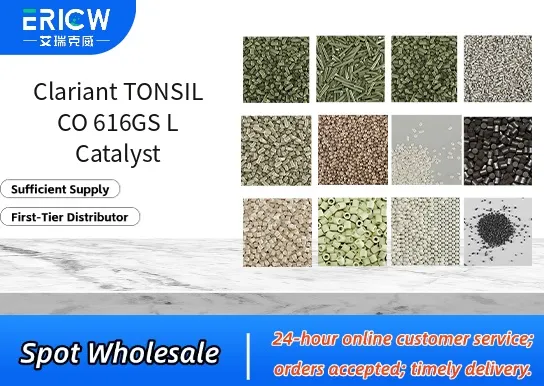
Highly selective acidic clay-based catalyst optimized for low-temperature condensation reactions.
Controlled acidity profile ensures consistent performance and minimizes side reactions such as polymerization or charring.
Thermally stable up to 200 °C, enabling reliable operation in continuous fixed-bed reactor systems.
Low dust generation and excellent mechanical strength reduce pressure drop and extend catalyst bed life.
Non-toxic, non-corrosive formulation supports safer handling and reduced environmental impact versus liquid acid alternatives.
Fine chemical synthesis — including Friedel-Crafts alkylation and acylation of aromatic compounds.
Production of fragrance intermediates, such as coumarin derivatives and alkylated benzenes.
Manufacturing of pharmaceutical precursors requiring mild, heterogeneous acid catalysis.
Dehydration and esterification reactions in specialty ester production (e.g., plasticizers and lubricant additives).
Upgrading bio-based feedstocks via selective dehydration of sugar derivatives and glycerol derivatives.
| Chemical Type | Acid-activated bentonitic clay |
| Product Form | Extruded cylindrical pellets (Ø 3 mm × 3–5 mm) |
| Appearance | Light grey to beige granular solid |
| Primary Applications | Heterogeneous acid-catalyzed condensation, alkylation, esterification, dehydration |
| Key Features | Controlled Brønsted acidity, high surface area, thermal stability up to 200 °C |
| Benefits | Reduced waste generation, simplified separation, reusable in fixed-bed configurations |
| pH (10% aqueous slurry) | 2.8–3.4 |
| Bulk Density | 0.75–0.85 g/cm³ |
Q1: What is the primary function of TONSIL CO 616GS L in polymer processing?
A: TONSIL CO 616GS L is a highly active, low-ash clay-based catalyst designed to promote controlled crosslinking and thermal stabilization in silicone rubber compounds, particularly during high-temperature vulcanization.
Q2: Is TONSIL CO 616GS L suitable for food-contact or medical-grade silicone applications?
A: While TONSIL CO 616GS L is formulated for high-purity performance and low volatility, its suitability for regulated end uses depends on full system validation—including final compound testing and compliance with applicable regional food contact or biocompatibility requirements. Users must conduct their own regulatory assessment.
Q3: How should TONSIL CO 616GS L be incorporated into silicone formulations?
A: It is typically added during the high-shear mixing stage of silicone base polymer processing. Good dispersion is essential—pre-blending with a portion of the polymer or using a masterbatch approach is recommended to ensure uniform distribution and optimal catalytic efficiency.
Q4: Does this catalyst require post-cure treatment to achieve full performance?
A: Post-curing is often beneficial to maximize crosslink density and thermal stability, especially in demanding applications. The need and conditions depend on the specific formulation, thickness, and end-use requirements—but TONSIL CO 616GS L supports efficient network development both during primary cure and optional post-cure cycles.
Contact With Us:
E-mail: wangxingqiang@ericwchem.com
Have a Questions? Call Us:
Add:
Building A1, Jiete Industrial Park, Huangpu District, Guangzhou City, Guangdong Province, China