English
 Español
 tiếng việt
 русский
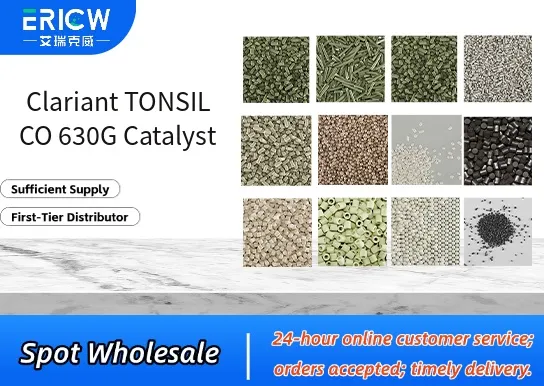
Highly selective acid catalyst optimized for condensation and esterification reactions.
Thermally stable solid with low volatility, enabling safer handling and reduced emissions.
Controlled surface acidity and uniform pore structure for consistent catalytic performance.
Non-corrosive to standard stainless-steel process equipment under recommended operating conditions.
Regenerable via controlled thermal treatment, supporting sustainable process economics.
Production of plasticizers (e.g., dioctyl phthalate and non-phthalate alternatives).
Synthesis of fragrance esters and flavor compounds in fine chemical manufacturing.
Catalysis of polyol ester formation for high-performance lubricants and hydraulic fluids.
Dehydration and cyclization steps in pharmaceutical intermediate synthesis.
| Chemical Type | Acidic activated clay (montmorillonite-based) |
| Product Form | Free-flowing granular solid |
| Appearance | Light grey to beige granules |
| Primary Applications | Esterification, condensation, dehydration, alkylation |
| Key Features | Controlled Brønsted acidity, mesoporous structure, low heavy metal content |
| Benefits | Reduced side reactions, simplified downstream separation, no neutralization waste |
| Storage Conditions | Keep in dry, well-ventilated area; protect from moisture and strong oxidizers |
Q1: What is the primary function of TONSIL CO 630G in polymer processing?
A: TONSIL CO 630G is a high-activity, acid-treated bentonite-based catalyst designed to promote controlled crosslinking and condensation reactions—particularly in silicone elastomer and RTV systems—enhancing cure speed, green strength development, and final mechanical performance without excessive exotherm.
Q2: Is TONSIL CO 630G compatible with platinum-catalyzed silicone formulations?
A: No—TONSIL CO 630G is an acid-clay catalyst and is not intended for use in platinum-cured (hydrosilylation) systems. It is specifically formulated for tin-catalyzed (e.g., dibutyltin dilaurate) or amine-catalyzed condensation-cure silicone chemistries where acidic activation supports hydrolysis and silanol condensation.
Q3: How should TONSIL CO 630G be incorporated into a formulation?
A: It is typically added during the high-shear mixing stage under dry or low-moisture conditions to ensure uniform dispersion. Pre-drying the catalyst is recommended if ambient humidity is elevated, and it should be introduced before moisture-sensitive components to avoid premature reaction onset.
Q4: Does TONSIL CO 630G require special storage conditions?
A: Yes—store in a cool, dry place in tightly sealed original packaging. Due to its hygroscopic nature, prolonged exposure to ambient humidity may reduce catalytic activity and affect batch consistency. Avoid storage near strong oxidizers or alkaline materials.
Contact With Us:
E-mail: wangxingqiang@ericwchem.com
Have a Questions? Call Us:
Add:
Building A1, Jiete Industrial Park, Huangpu District, Guangzhou City, Guangdong Province, China