English
 Español
 tiếng việt
 русский
Highly selective ammonia oxidation catalyst optimized for low-NOx operation in nitric acid plants.
Enhanced thermal stability and long service life under demanding industrial operating conditions.
Robust resistance to poisoning from trace impurities such as chloride, sulfur, and phosphorus compounds.
Consistent performance across wide load ranges—enabling flexible plant operation and energy efficiency.
Pre-shaped, mechanically stable pellets designed for low pressure drop and uniform gas distribution.
Nitric acid production via the Ostwald process in medium- to large-scale fertilizer plants.
Ammonia-to-nitric oxide conversion in integrated caprolactam and adipic acid manufacturing facilities.
Retrofit applications in existing nitric acid units requiring reduced NOx emissions and improved catalyst longevity.
On-site nitric acid generation for specialty chemical synthesis and pharmaceutical intermediates.
Greenfield nitric acid plants targeting compliance with stringent environmental regulations (e.g., EU BREF, US EPA NSPS).
| Chemical Type | Platinum-rhodium alloy on ceramic support (Al2O3-based) |
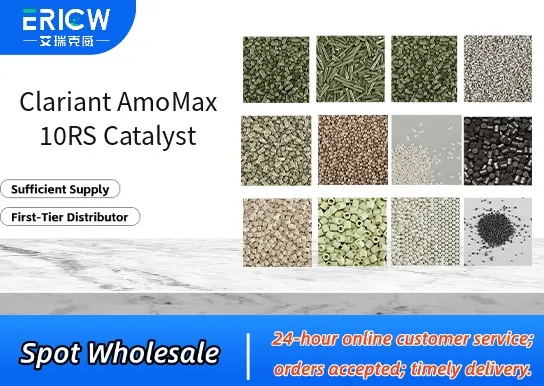
| Product Form | Cylindrical pellets (3.0 mm diameter × 3.0 mm height) |
| Appearance | Greyish metallic luster, free-flowing granular solid |
| Primary Applications | Ammonia oxidation for nitric acid production |
| Key Features | Low NOx selectivity, high Pt-Rh dispersion, thermally sinter-resistant |
| Benefits | Reduced abatement costs, extended catalyst cycle life, lower platinum group metal (PGM) consumption |
| Storage Conditions | Store in dry, cool, well-ventilated area; protect from mechanical impact and moisture |
| Handling Precautions | Avoid inhalation of dust; use appropriate PPE during loading/unloading |
Q1: What is the primary function of AmoMax 10RS in industrial ammonia synthesis?
A: AmoMax 10RS is a high-activity, ruthenium-based ammonia synthesis catalyst designed to enhance conversion efficiency and enable operation at lower pressure and temperature conditions compared to conventional iron-based catalysts.
Q2: How does AmoMax 10RS differ from traditional magnetite-based ammonia catalysts?
A: Unlike conventional Fe₃O₄-derived catalysts, AmoMax 10RS features a supported ruthenium active phase that delivers significantly higher intrinsic activity per unit mass, allowing for reduced reactor volume or increased throughput under comparable process conditions.
Q3: Is special activation or pre-treatment required before commissioning AmoMax 10RS?
A: Yes — AmoMax 10RS requires careful in-situ reduction under controlled hydrogen flow and gradual temperature ramping. Clariant provides detailed start-up guidelines to ensure optimal dispersion of the ruthenium phase and long-term structural stability.
Q4: What are key handling and storage considerations for this catalyst?
A: Due to its pyrophoric nature in reduced form, AmoMax 10RS must be stored and handled under inert atmosphere (e.g., nitrogen or argon) and protected from moisture and air exposure. Unreduced catalyst is supplied in passivated form but still requires dry, oxygen-free storage conditions.
Q5: Can AmoMax 10RS be used in existing ammonia plants retrofitted with low-pressure synthesis loops?
A: Yes — AmoMax 10RS is specifically engineered for integration into modernized or retrofit ammonia plants operating at reduced pressures (e.g., 80–150 bar), where its high low-pressure activity helps improve energy efficiency without requiring major hardware modifications.
Contact With Us:
E-mail: wangxingqiang@ericwchem.com
Have a Questions? Call Us:
Add:
Building A1, Jiete Industrial Park, Huangpu District, Guangzhou City, Guangdong Province, China