English
 Español
 tiếng việt
 русский
Highly selective hydrogenation catalyst for sulfur-sensitive refinery streams.
Exceptional resistance to poisoning by nitrogen compounds and metals.
Optimized pore structure enabling superior diffusion and reduced coking.
Thermally stable formulation suitable for fixed-bed hydrotreating units operating up to 400 °C.
Low-pressure operation capability, enhancing energy efficiency and process safety.
Hydrodesulfurization (HDS) of naphtha and light distillates in refineries.
Selective hydrogenation of diolefins and olefins in FCC gasoline blending streams.
Treatment of pyrolysis gasoline (pygas) to meet stringent sulfur and olefin specifications.
Pre-hydrotreating of feedstocks for catalytic reforming units.
Deep desulfurization in ultra-low-sulfur diesel (ULSD) production pathways.
| Chemical Type | Ni-Mo on high-surface-area alumina support |
| Product Form | Extrudates (1.6 mm tri-lobe) |
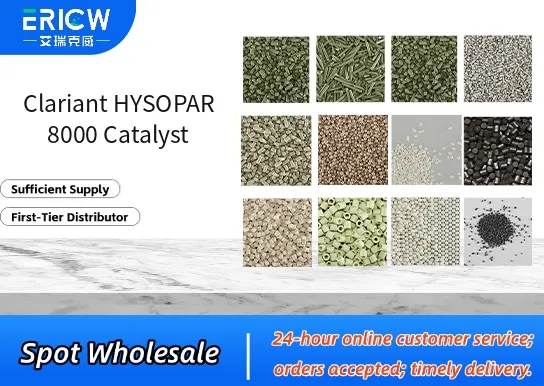
| Appearance | Gray-black cylindrical extrudates |
| Primary Applications | Hydrodesulfurization, selective hydrogenation, pygas treatment |
| Key Features | High selectivity, poison resistance, thermal stability, low-pressure performance |
| Benefits | Extended cycle life, improved product quality, reduced hydrogen consumption, lower operating costs |
| Typical Bulk Density | 0.85–0.95 g/cm³ |
| Recommended Activation | In-situ sulfidation with DMDS or elemental sulfur under controlled H₂ atmosphere |
Q1: What is the primary function of HYSOPAR 8000 in polymer processing?
A: HYSOPAR 8000 is a highly selective hydrogenation catalyst designed to reduce unsaturated bonds—particularly vinyl aromatic groups—in thermoplastic elastomers and styrenic block copolymers, thereby improving thermal stability, UV resistance, and long-term mechanical performance.
Q2: Is HYSOPAR 8000 compatible with common polymer processing methods?
A: Yes—it is formulated for compatibility with standard melt-processing techniques including extrusion, injection molding, and compounding. It demonstrates good thermal stability under typical processing conditions and minimal volatility or decomposition up to 280 °C.
Q3: How is HYSOPAR 8000 typically incorporated into polymer formulations?
A: It is generally introduced during melt compounding, either as a masterbatch or directly alongside the base polymer. Dosage depends on formulation requirements but typically ranges from 0.1% to 2% by weight relative to the polymer matrix.
Q4: Does HYSOPAR 8000 require pre-activation or special handling before use?
A: No pre-activation is required—the catalyst is supplied in a ready-to-use form, stabilized for ambient storage. For optimal performance, it is recommended to minimize prolonged exposure to moisture and oxygen prior to processing.
Contact With Us:
E-mail: wangxingqiang@ericwchem.com
Have a Questions? Call Us:
Add:
Building A1, Jiete Industrial Park, Huangpu District, Guangzhou City, Guangdong Province, China