English
 Español
 tiếng việt
 русский
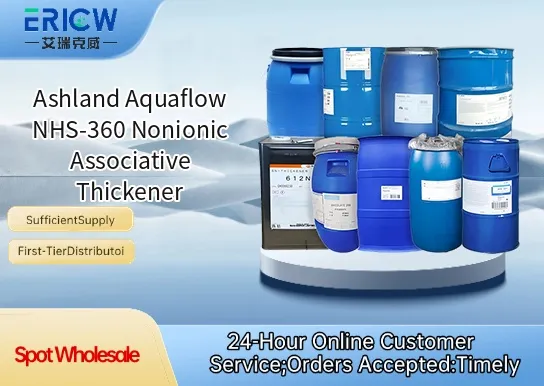
Delivers excellent rheology control and high-shear viscosity stability in water-based formulations.
Provides outstanding sag resistance and anti-drip performance in architectural coatings.
Offers low foaming characteristics, enabling compatibility with standard defoamers and processing conditions.
Delivers robust freeze-thaw stability and long-term storage performance in latex-based systems.
Enables efficient thickening at low dosage levels, improving cost-effectiveness and formulation flexibility.
Interior and exterior architectural paints and primers.
Textured decorative coatings and stucco finishes.
Water-based wood stains and clear finishes.
Industrial maintenance coatings for metal and masonry substrates.
Tile grouts and cementitious repair mortars.
| Chemical Type | Nonionic associative polyurethane (HEUR) |
| Product Form | Aqueous dispersion |
| Appearance | Opaque white to off-white liquid |
| pH (1% aqueous solution) | 7.0 – 9.0 |
| Active Content (wt%) | 30.0 ± 1.0% |
| Viscosity (Brookfield RVT, spindle #3, 20 rpm, 25°C) | 500 – 2,500 cP |
| Primary Applications | Architectural coatings, industrial coatings, construction mortars |
| Key Features | Rheology modification, sag resistance, shear-thinning behavior |
Q1: What types of formulations is Aquaflow NHS-360 best suited for?
A: Aquaflow NHS-360 is specifically designed for water-based architectural and industrial coatings, including interior and exterior paints, primers, and texture coatings. Its nonionic associative structure provides excellent rheology control in low-VOC and zero-VOC systems, particularly where good sag resistance, spatter resistance, and brush/roller application performance are required.
Q2: How does NHS-360 differ from ionic thickeners like CMC or HEC?
A: Unlike ionic cellulose ethers (e.g., HEC) or anionic thickeners, NHS-360 functions via hydrophobic association in aqueous media—forming reversible network structures without relying on charge interactions. This makes it less sensitive to electrolytes, pH shifts, and co-solvents, offering more consistent viscosity performance across diverse formulation conditions.
Q3: Can NHS-360 be used in combination with other rheology modifiers?
A: Yes, NHS-360 is commonly used in hybrid thickener systems—for example, paired with fumed silica for enhanced high-shear viscosity or with low-molecular-weight associative thickeners to fine-tune flow and leveling. Compatibility should be verified empirically, as synergistic or antagonistic effects may occur depending on the specific co-thickener and formulation matrix.
Q4: What is the recommended addition method for optimal performance?
A: For best results, NHS-360 should be added during the let-down stage, after pigments and primary binders are dispersed. Pre-dilution in water or a compatible co-solvent (e.g., propylene glycol) is recommended to ensure uniform dispersion. High-shear mixing may be required initially, followed by adequate hold time to allow full associative network development.
Contact With Us:
E-mail: wangxingqiang@ericwchem.com
Have a Questions? Call Us:
Add:
Building A1, Jiete Industrial Park, Huangpu District, Guangzhou City, Guangdong Province, China