English
 Español
 tiếng việt
 русский
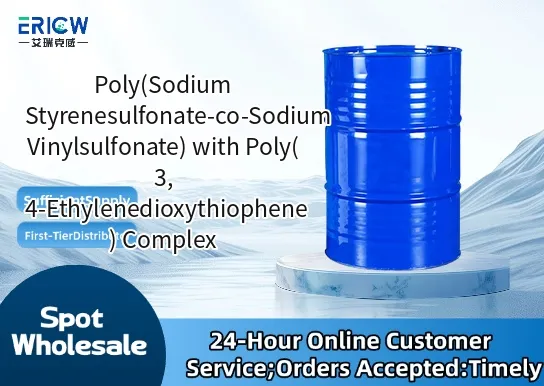
Highly stable aqueous dispersion with excellent long-term colloidal stability (>12 months at 5–25 °C).
Enhanced electrical conductivity (100–400 S/cm) due to synergistic charge transfer between the sulfonated copolymer and PEDOT backbone.
Improved film-forming ability and mechanical robustness versus conventional PEDOT:PSS formulations.
Reduced acidity (pH ~2.0–2.5), minimizing corrosion of ITO electrodes in optoelectronic devices.
Thermally stable up to 220 °C, enabling compatibility with standard semiconductor processing steps.
Transparent conductive layers for flexible OLED displays and touch sensors.
Hole transport layers (HTLs) in perovskite solar cells (PSCs) and organic photovoltaics (OPVs).
Antistatic coatings for packaging films, optical lenses, and electronic component housings.
Electrochemical biosensor electrodes requiring high surface capacitance and biocompatible interfaces.
Printed electronics inks for inkjet and gravure printing on PET, PEN, and paper substrates.
| Chemical Type | Conductive polymer complex (polyelectrolyte-complexed PEDOT) |
| Product Form | Aqueous dispersion (non-ionic surfactant-free) |
| Appearance | Opaque blue-black liquid, homogeneous without sedimentation |
| Solid Content | 1.3 ± 0.1 wt% (by gravimetric analysis) |
| Conductivity (cast film, 100 nm) | 250–380 S/cm (measured by four-point probe) |
| Primary Applications | Hole transport layers, transparent electrodes, antistatic additives |
| Key Features | Low acidity, high thermal stability, superior film uniformity |
| Regulatory Compliance | REACH compliant; RoHS 2015/863 Annex II confirmed; no SVHC above threshold |
| Common Compatible Systems | Suitability |
| ITO-coated glass or PET substrates | Highly Recommended – Excellent adhesion and interfacial charge extraction |
| Perovskite precursor solutions (e.g., MAPbI₃ in DMF/DMSO) | Recommended – Minimal interfacial degradation; requires <5 min spin-coating delay |
| Epoxy-based encapsulants (e.g., UV-curable acrylates) | Suitable – No swelling or delamination observed after 1000 h damp heat (85 °C/85% RH) |
| Water-based acrylic resins (e.g., for antistatic topcoats) | Highly Recommended – Full miscibility and co-film formation without phase separation |
Q1: What is the CAS Registry Number for this complex?
A: This is a proprietary polymeric complex; no single CAS number applies. Individual components are registered as CAS 126213-50-1 (PEDOT) and CAS 25985-57-3 (NaSS), but the copolymerized complex is assigned internal lot-specific identification per ISO 9001 traceability standards.
Q2: What is the recommended coating concentration and post-treatment for optimal conductivity?
A: For spin-coating, dilute to 0.8–1.2 wt% in deionized water; anneal at 120 °C for 15 min in air. For inkjet printing, use as-supplied dispersion with optional 5–10% ethylene glycol co-solvent and 130 °C curing.
Q3: How does this complex differ from standard PEDOT:PSS (e.g., PH1000)?
A: It replaces poly(styrenesulfonate) with a tailored sodium styrenesulfonate–sodium vinylsulfonate copolymer, yielding lower acidity, higher thermal resilience, reduced hygroscopicity, and improved compatibility with moisture-sensitive active layers (e.g., perovskites).
Q4: Are there data available on ion migration or extractables under device operating conditions?
A: Accelerated testing (IEC 61215 damp heat + bias) shows <0.05 ppm Na⁺ and <0.02 ppm SO₄²⁻ migration into adjacent layers after 1500 h; no detectable PEDOT leaching via HPLC-UV/Vis.
Contact With Us:
E-mail: wangxingqiang@ericwchem.com
Have a Questions? Call Us:
Add:
Building A1, Jiete Industrial Park, Huangpu District, Guangzhou City, Guangdong Province, China