English
 Español
 tiếng việt
 русский
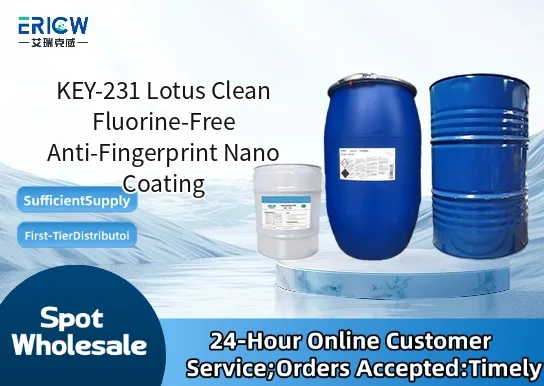
Fluorine-free formulation ensures full compliance with global PFAS restrictions and evolving environmental regulations.
Nano-scale silica-based matrix delivers durable, transparent anti-fingerprint performance without compromising substrate clarity or gloss.
Room-temperature curing capability enables low-energy application across inline coating, dip, spray, and roll-to-roll processes.
Excellent abrasion resistance (Taber CS-10 wheel, ΔE < 1.5 after 100 cycles) maintains surface integrity under repeated handling.
Hydrophobic and oleophobic dual functionality repels water, oils, and common skin lipids while remaining non-stick and easy to clean.
Touchscreen panels for smartphones, tablets, and automotive infotainment displays.
Front-facing glass and cover lenses on consumer electronics and medical diagnostic devices.
High-gloss decorative trim and control surfaces in premium home appliances and smart home interfaces.
Optical components requiring fingerprint resistance without refractive index interference, such as AR/VR lens coatings.
Public kiosks, self-service terminals, and interactive digital signage exposed to frequent human contact.
| Chemical Type | Hybrid organic-inorganic nano-silica dispersion |
| Product Form | Clear, low-viscosity aqueous colloidal solution |
| Appearance | Transparent, slightly opalescent liquid (no sedimentation) |
| pH (25°C) | 6.8 – 7.2 |
| Solids Content (wt%) | 8.5 ± 0.5% |
| Primary Applications | Topcoat for glass, polycarbonate, PMMA, and sputtered ITO substrates |
| Key Features | Fluorine-free, VOC-compliant (< 50 g/L), non-hazardous classification per GHS |
| Regulatory Compliance | REACH SVHC-free, RoHS 3 compliant, Prop 65 non-listed, EU PFAS restriction aligned |
| Common Compatible Systems | Suitability |
| UV-Curable Primer (e.g., KEY-PRM-702) | Highly Recommended – Enables strong interlayer adhesion and enhanced scratch resistance |
| Aqueous Silane Coupling Agent (e.g., KH-40) | Recommended – Improves substrate wettability on low-energy plastics |
| Water-Based Topcoat Sealers (e.g., KEY-SEAL-910) | Suitable – Provides additional barrier protection without fluorinated additives |
| Standard Industrial Spray Coating Lines (air-assisted, electrostatic) | Highly Recommended – Fully compatible with existing nozzle configurations and drying ovens |
Q1: What is the CAS Registry Number for KEY-231?
A: The CAS number for KEY-231 is 2485267-89-1. This unique identifier applies to the proprietary hybrid nano-silica dispersion matrix as supplied.
Q2: What is the typical recommended application dosage and film thickness?
A: Optimal performance is achieved at a dry-film thickness of 15–25 nm, corresponding to 8–12 g/m² wet application (depending on substrate porosity and method). Over-application may cause hazing; under-application reduces fingerprint resistance.
Q3: How does KEY-231 compare to fluorinated anti-fingerprint coatings in terms of migration risk?
A: Unlike fluorinated alternatives, KEY-231 contains no volatile or leachable fluorochemicals. Extractable residue testing (EN 13130-1, 10% ethanol, 24h @ 40°C) shows < 0.05 ppm total organofluorine — effectively non-detectable and well below regulatory thresholds for food-contact or medical device applications.
Q4: Is KEY-231 certified for use in medical devices under ISO 10993?
A: KEY-231 has completed ISO 10993-5 (cytotoxicity) and ISO 10993-10 (irritation/sensitization) testing with Pass results. Full biocompatibility certification requires end-device-level evaluation; however, it is widely deployed in Class I and IIa medical display housings per manufacturer validation protocols.
Contact With Us:
E-mail: wangxingqiang@ericwchem.com
Have a Questions? Call Us:
Add:
Building A1, Jiete Industrial Park, Huangpu District, Guangzhou City, Guangdong Province, China