English
 Español
 tiếng việt
 русский
High thermal stability with continuous service up to 200 °C.
Excellent electrical insulation properties across wide temperature and frequency ranges.
Good adhesion to metals, glass, and common engineering plastics without primers.
Low surface energy providing inherent water repellency and release characteristics.
Compatible with organic resins and pigments for hybrid formulation flexibility.
Electrical encapsulants for transformers, sensors, and power modules.
Heat-resistant coatings for automotive under-hood components.
Binders in high-temperature ceramic and refractory coatings.
Matrix resin in composite laminates for aerospace and industrial tooling.
Base resin for specialty release coatings on silicone-treated papers and films.
| Chemical Type | Methyl-phenyl silicone resin |
| Product Form | Clear to light amber liquid |
| Appearance | Homogeneous, low-viscosity liquid |
| Primary Applications | High-temperature coatings, electrical encapsulation, binders |
| Key Features | Thermally stable, electrically insulating, adherent, hydrophobic |
| Benefits | Extended service life in harsh environments, simplified processing, reduced need for primers |
| Storage Conditions | Store below 30 °C in tightly sealed containers; protect from moisture |
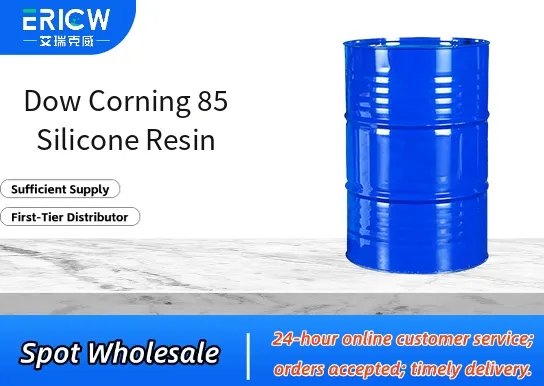
Q1: What is the primary function of Dow Corning 85 Silicone Resin in coating and ink formulations?
A: Dow Corning 85 is a methyl-phenyl silicone resin designed to enhance surface properties—particularly slip, mar resistance, and substrate wetting—without significantly affecting film clarity or flexibility. It functions as a surface modifier that migrates to the air-interface during film formation.
Q2: Is Dow Corning 85 compatible with common organic solvent-based systems?
A: Yes, it exhibits good solubility in aromatic hydrocarbons (e.g., xylene, toluene), ketones (e.g., MEK, acetone), and certain esters. Compatibility with polar solvents or water-based systems is limited and typically requires formulation adjustment or use of compatible emulsifiers or dispersants.
Q3: How does Dow Corning 85 differ from reactive silicone additives or silicone oils?
A: Unlike silicone oils or reactive silanes, Dow Corning 85 is a non-reactive, thermoplastic resin that provides durable surface effects without covalent bonding to the matrix. Its performance is based on controlled phase separation and surface segregation rather than chemical crosslinking or permanent anchoring.
Q4: Can Dow Corning 85 be used in high-temperature curing applications?
A: Yes—it retains functionality in thermal cure cycles up to approximately 200 °C, making it suitable for industrial baking finishes and powder coating overprint varnishes. Prolonged exposure above this range may lead to gradual oxidative degradation and reduced surface effect longevity.
Contact With Us:
E-mail: wangxingqiang@ericwchem.com
Have a Questions? Call Us:
Add:
Building A1, Jiete Industrial Park, Huangpu District, Guangzhou City, Guangdong Province, China