English
 Español
 tiếng việt
 русский
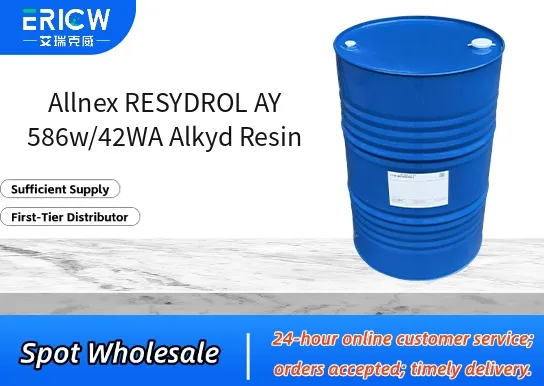
Water-reducible alkyd resin enabling low-VOC, high-solids coatings formulations.
Excellent gloss retention and long-term color stability in exterior applications.
Good compatibility with acrylic emulsions and other waterborne resins for hybrid systems.
Fast ambient drying with balanced through-dry and surface dry performance.
Enhanced hardness development and mar resistance in cured films.
Architectural waterborne interior and exterior trim paints.
Industrial maintenance coatings for metal substrates.
Wood finishes requiring low-odor, fast-drying performance.
Refinish coatings for furniture and cabinetry.
General-purpose protective coatings for agricultural and construction equipment.
| Chemical Type | Water-reducible alkyd resin (modified soy oil-based) |
| Product Form | Opaque white to off-white aqueous dispersion |
| Appearance | Homogeneous liquid, slight opalescence |
| pH (10% solution) | 7.5 – 8.5 |
| Solids Content (wt%) | 42 ± 1 |
| Viscosity (Brookfield, RVT, #2 spindle, 20 rpm, 25°C) | 200 – 600 mPa·s |
| Minimum Film Formation Temperature (MFFT) | ≈ 15°C |
| Primary Applications | Waterborne architectural and industrial maintenance coatings |
Q1: What is the primary function of RESYDROL AY 586w/42WA in waterborne alkyd coatings?
A: RESYDROL AY 586w/42WA serves as a reactive coalescing agent and film-forming aid, enhancing particle fusion, improving early water resistance, and supporting ambient-temperature film formation in low-VOC, water-reducible alkyd systems.
Q2: Is this resin compatible with common waterborne acrylic or vinyl acetate dispersions?
A: Yes — RESYDROL AY 586w/42WA is formulated for broad compatibility with waterborne acrylics, styrene-acrylics, and VAE dispersions, enabling hybrid alkyd-acrylic systems with balanced drying performance and durability.
Q3: How does RESYDROL AY 586w/42WA contribute to VOC reduction?
A: As a water-dispersible alkyd resin, it eliminates the need for aromatic hydrocarbon solvents during manufacturing and application, supporting formulations that meet stringent regional VOC limits without compromising film integrity or gloss retention.
Q4: Can it be used in interior architectural coatings requiring low odor and rapid dry-to-touch?
A: Yes — its optimized molecular design supports fast physical drying and minimal residual odor, making it well-suited for interior trim, woodwork, and cabinetry coatings where user acceptance and recoatability are critical.
Contact With Us:
E-mail: wangxingqiang@ericwchem.com
Have a Questions? Call Us:
Add:
Building A1, Jiete Industrial Park, Huangpu District, Guangzhou City, Guangdong Province, China