English
 Español
 tiếng việt
 русский
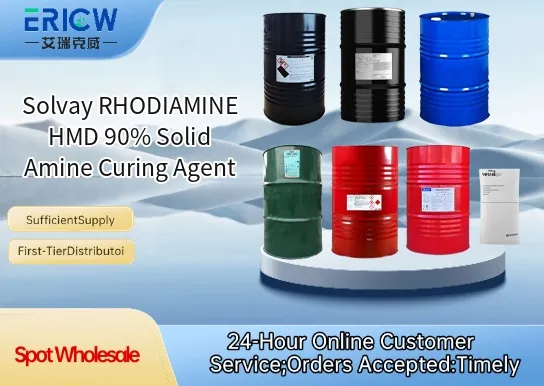
High amine functionality with consistent 90% solid content for precise stoichiometric control in epoxy formulations.
Excellent reactivity at ambient and elevated temperatures, enabling fast gel times and reduced cycle times in composite manufacturing.
Low volatility and negligible vapor pressure—enhances workplace safety and reduces VOC emissions during processing.
Superior compatibility with standard epoxy resins (e.g., DGEBA, novolacs), yielding high-glass-transition, chemically resistant cured networks.
Crystalline solid form ensures long-term storage stability without phase separation or sedimentation.
Aerospace structural composites requiring high Tg, low moisture absorption, and flame-retardant performance.
Wind turbine blade adhesives and matrix resins for improved fatigue resistance and thermal stability.
Electrical insulation systems in high-voltage transformers and bushings.
Automotive under-hood components exposed to sustained thermal cycling and chemical exposure.
Industrial tooling and molds where dimensional stability and surface hardness are critical.
| Chemical Type | Aliphatic diamine (hexamethylenediamine derivative) |
| Product Form | Free-flowing crystalline solid |
| Appearance | White to off-white granular crystals |
| Amine Value | 450–470 mg KOH/g |
| Assay (HMD Content) | ≥ 90 wt% |
| Melting Range | 85–92 °C |
| Moisture Content | ≤ 0.5 wt% |
| Primary Applications | Epoxy curing agent for high-performance thermosets |
Q1: What is the primary function of RHODIAMINE HMD in epoxy systems?
A: RHODIAMINE HMD serves as a highly reactive solid amine curing agent for epoxy resins, enabling rapid crosslinking at elevated temperatures to deliver excellent thermal stability, chemical resistance, and mechanical performance in high-performance composites and coatings.
Q2: How does RHODIAMINE HMD compare to liquid amine curing agents in terms of handling and processing?
A: As a free-flowing solid with low dust generation and no volatile organic content, RHODIAMINE HMD offers improved workplace safety, easier metering and blending, better storage stability, and reduced risk of amine blush compared to many liquid alternatives.
Q3: What types of epoxy resins is RHODIAMINE HMD typically compatible with?
A: RHODIAMINE HMD demonstrates broad compatibility with standard bisphenol-A and bisphenol-F epoxy resins, as well as novolac epoxies—particularly where enhanced heat resistance and dimensional stability are required in aerospace, electrical insulation, or structural adhesive applications.
Q4: Is RHODIAMINE HMD suitable for food-contact or potable water applications?
A: RHODIAMINE HMD is not pre-qualified for direct food-contact or potable water applications. Its suitability must be evaluated case-by-case based on final cured system testing and compliance with applicable regulatory frameworks in the target market.
Q5: What is the recommended cure profile for optimal performance?
A: A typical thermal cure involves an initial dwell at 80–100 °C followed by post-cure at 130–160 °C; exact time/temperature profiles depend on part geometry, resin selection, and desired property balance—optimization is recommended via DSC and mechanical testing.
Contact With Us:
E-mail: wangxingqiang@ericwchem.com
Have a Questions? Call Us:
Add:
Building A1, Jiete Industrial Park, Huangpu District, Guangzhou City, Guangdong Province, China