English
 Español
 tiếng việt
 русский
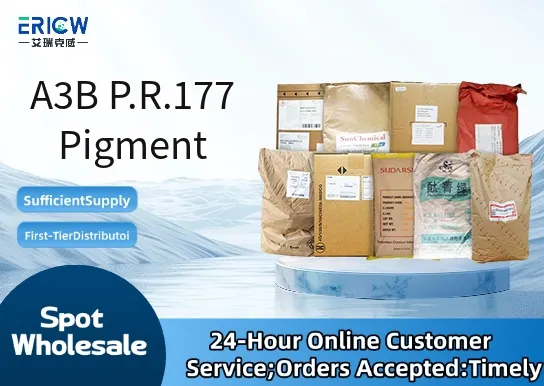
High chromatic strength with excellent color purity in the red shade range.
Outstanding thermal stability up to 280 °C, suitable for high-temperature processing.
Good lightfastness (ISO 105-B02: Grade 7–8) and weather resistance in outdoor applications.
Low volatility and minimal migration in polymer matrices, ensuring long-term color integrity.
Free-flowing powder form with consistent particle size distribution for uniform dispersion.
Polyolefin masterbatches (PP, PE) for automotive interior components.
Engineering plastics including ABS and PS for consumer electronics housings.
Coating systems for industrial metal finishes requiring durable red hues.
High-performance inks for flexible packaging films with FDA-compliant formulations.
Construction materials such as colored PVC profiles and roofing membranes.
| Chemical Type | Azo pigment (Pigment Red 177) |
| Product Form | Free-flowing dry powder |
| Appearance | Red to reddish-brown fine powder |
| Primary Applications | Polymer coloring, coatings, inks |
| Key Features | Thermal stability, low migration, high tinctorial strength |
| Benefits | Consistent batch-to-batch performance, easy dispersion, regulatory compliance support |
| Recommended Dispersant | Standard polymeric dispersants for non-polar media |
| Storage Conditions | Store in cool, dry place; avoid direct sunlight and moisture |
Q1: What is the primary chemical class and typical application domain for A3B P.R.177 Pigment?
A: A3B P.R.177 is a high-performance organic pigment classified under the perylene red family, widely used in demanding industrial applications such as automotive coatings, high-gloss architectural paints, and engineering plastics where excellent lightfastness, thermal stability, and color strength are required.
Q2: Is A3B P.R.177 suitable for food-contact or pharmaceutical applications?
A: No — A3B P.R.177 is not certified for direct food-contact or pharmaceutical use. It is formulated and tested for industrial and decorative applications only; customers requiring regulatory compliance for such end-uses should consult our dedicated food-grade pigment portfolio.
Q3: How does A3B P.R.177 perform under elevated processing temperatures, particularly in polymer compounding?
A: This pigment demonstrates robust thermal stability and retains its color integrity during standard melt-processing conditions for polyolefins and engineering thermoplastics, typically up to 280 °C for short residence times. Performance may vary depending on resin matrix, shear history, and additive interactions.
Q4: What dispersion characteristics can be expected when incorporating A3B P.R.177 into solvent-based versus water-based systems?
A: In solvent-based systems, A3B P.R.177 disperses readily with conventional high-speed dispersers or bead mills using standard non-ionic or anionic dispersants. In water-based formulations, stable dispersion generally requires optimized surfactant packages and may benefit from pre-wetting or milling protocols tailored to the specific binder system.
Contact With Us:
E-mail: wangxingqiang@ericwchem.com
Have a Questions? Call Us:
Add:
Building A1, Jiete Industrial Park, Huangpu District, Guangzhou City, Guangdong Province, China