English
 Español
 tiếng việt
 русский
High thermal stability up to 800 °C, suitable for high-temperature ceramic and enamel applications.
Excellent lightfastness and weather resistance, ensuring long-term color retention in outdoor exposure.
Non-toxic, heavy-metal-free formulation compliant with global regulatory standards including EN 71-3 and RoHS.
Consistent particle size distribution for superior dispersion and uniform color development in diverse matrices.
Chemically inert and alkali-resistant, maintaining integrity in cementitious and alkaline coating systems.
Ceramic glazes and tiles for architectural and sanitaryware applications.
High-performance architectural coatings and façade paints.
Concrete and precast concrete coloring for structural and decorative elements.
Plastic masterbatches for automotive interior components and construction profiles.
Enamels and vitreous coatings for domestic appliances and industrial equipment.
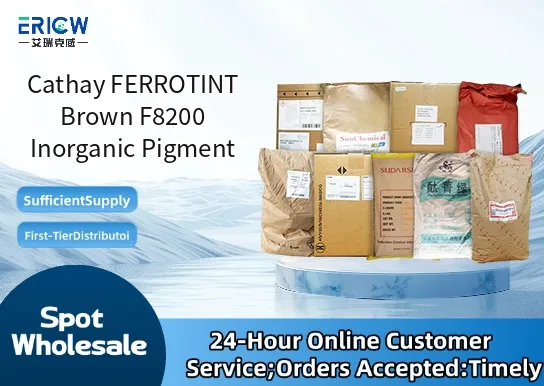
| Chemical Type | Iron oxide-based complex inorganic colored pigment (spinel structure) |
| Product Form | Free-flowing dry powder |
| Appearance | Uniform reddish-brown granular powder |
| Primary Applications | Ceramics, architectural coatings, concrete, plastics, enamels |
| Key Features | Heat stable, lightfast, non-toxic, alkali resistant |
| Benefits | Color consistency, low oil absorption, excellent dispersibility |
| Storage Conditions | Store in cool, dry, well-ventilated area away from direct sunlight and moisture |
| Regulatory Compliance | Compliant with REACH, RoHS, EN 71-3, and FDA 21 CFR 178.3297 (for indirect food contact) |
Q1: What is the primary chemical composition of Cathay FERROTINT Brown F8200?
A: Cathay FERROTINT Brown F8200 is an iron oxide-based inorganic pigment, primarily composed of complex mixed-phase iron oxides and hydroxides, engineered to deliver consistent brown hue, high opacity, and excellent thermal stability.
Q2: Is this pigment suitable for use in exterior architectural coatings?
A: Yes — F8200 exhibits strong UV resistance, low photocatalytic activity, and excellent weathering performance, making it well-suited for long-term outdoor applications including façade paints, stucco, and concrete stains.
Q3: How does F8200 perform in alkaline environments such as cementitious systems?
A: It demonstrates outstanding alkali resistance due to its fully calcined inorganic structure, maintaining color integrity and dispersion stability in mortars, grouts, and precast concrete without blooming or fading.
Q4: Can F8200 be used in food-contact coatings or plastics?
A: While F8200 meets general industrial safety requirements for inorganic pigments, it is not pre-qualified for direct food-contact applications. Formulators must conduct full regulatory assessment and migration testing per intended end-use and regional compliance frameworks.
Q5: What is the typical dosage range when incorporating F8200 into solvent-based industrial coatings?
A: Dosage depends on desired shade intensity and film thickness, but it is typically used at low concentrations — generally ranging from 0.1% to 2% by weight relative to total formulation solids — with optimal dispersion achieved via standard high-shear mixing.
Contact With Us:
E-mail: wangxingqiang@ericwchem.com
Have a Questions? Call Us:
Add:
Building A1, Jiete Industrial Park, Huangpu District, Guangzhou City, Guangdong Province, China