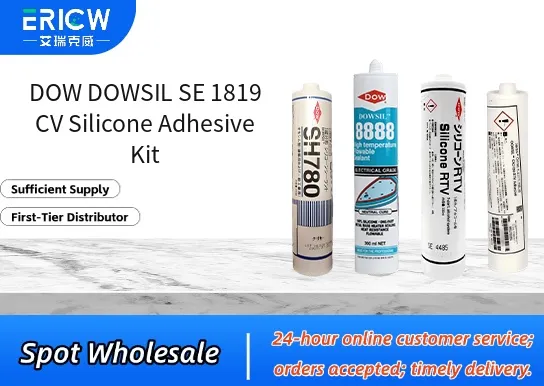
Two-component, addition-cure silicone adhesive system offering low viscosity and excellent flow characteristics for precise dispensing.
Fast room-temperature cure with optional heat acceleration, enabling rapid production throughput and reduced cycle times.
Exceptional adhesion to a broad range of substrates including metals, glass, ceramics, and engineered plastics without primers.
Outstanding thermal stability and long-term reliability across operating temperatures from –55 °C to +200 °C.
Low compression set and high elasticity ensure durable sealing and bonding performance under dynamic mechanical stress.
Aerospace component assembly requiring vibration-resistant structural bonding and environmental sealing.
Automotive sensor encapsulation and electronic control unit (ECU) potting where thermal management and dielectric integrity are critical.
Medical device assembly demanding biocompatibility-compliant materials and cleanroom-compatible processing.
Industrial LED lighting modules requiring optical clarity, thermal cycling resistance, and UV stability.
High-reliability power electronics packaging including inverters, converters, and battery module interconnects.
| Chemical Type | Platinum-catalyzed addition-cure silicone |
| Product Form | Two-part liquid kit (Part A: base; Part B: catalyst) |
| Appearance | Part A: translucent colorless to pale amber liquid; Part B: colorless to pale yellow liquid |
| Primary Applications | Structural bonding, encapsulation, potting, and gasketing |
| Key Features | Low viscosity, fast RT/heat cure, primerless adhesion, high elongation |
| Benefits | Improved manufacturing efficiency, enhanced reliability, reduced process complexity |
| Cure Mechanism | Addition reaction (no by-products) |
| Storage Stability | ≥6 months at 25 °C in unopened containers |
Q1: What is the typical cure mechanism for DOWSIL SE 1819 CV?
A: DOWSIL SE 1819 CV is a two-component addition-cure silicone adhesive system that cures at room temperature or with mild heat activation. It relies on platinum-catalyzed hydrosilylation between vinyl and Si–H functional groups, offering low exotherm, minimal shrinkage, and no by-products.
Q2: Can this adhesive be used for bonding dissimilar substrates such as glass, metal, and engineered plastics?
A: Yes — DOWSIL SE 1819 CV is formulated to provide strong, durable adhesion to a broad range of substrates including glass, aluminum, stainless steel, polycarbonate, and PBT, without requiring primers in many cases. Surface cleanliness and compatibility testing are recommended for critical applications.
Q3: How does the mixed viscosity and pot life support automated dispensing processes?
A: The kit offers a balanced mix viscosity suitable for precision metering and mixing systems, with a practical working time (pot life) of several hours at room temperature — enabling consistent, repeatable dispensing in high-volume assembly lines without premature gelation.
Q4: Is post-cure required to achieve full mechanical and thermal performance?
A: While full physical properties develop after room-temperature cure, a controlled thermal post-cure (e.g., 60–120 °C for 30–120 minutes) is often applied to optimize compression set resistance, thermal stability, and long-term reliability — especially in demanding automotive or electronics environments.
Contact With Us:
E-mail: wangxingqiang@ericwchem.com
Have a Questions? Call Us:
Add:
Building A1, Jiete Industrial Park, Huangpu District, Guangzhou City, Guangdong Province, China
 English
 Español
 tiếng việt
 русский