English
 Español
 tiếng việt
 русский
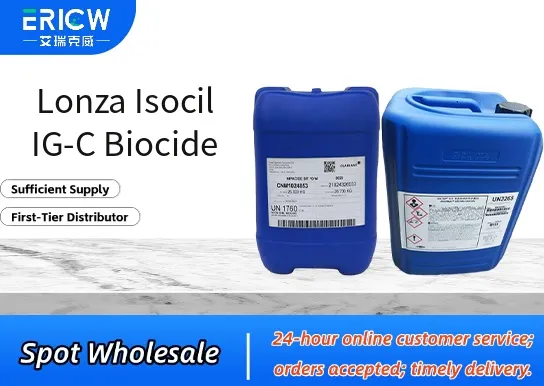
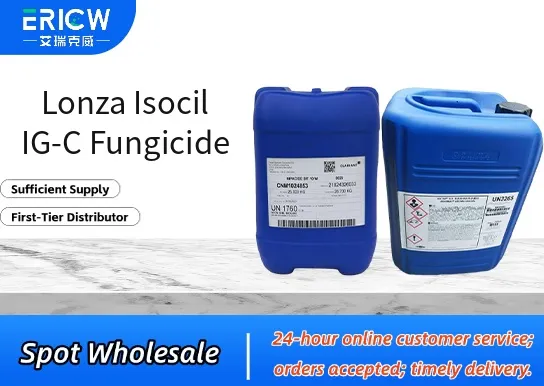
Highly effective broad-spectrum biocide against bacteria, fungi, and algae in industrial water systems.
Stable performance across a wide pH range (pH 6–9) and tolerant to common water treatment additives.
Low foaming formulation suitable for high-shear and recirculating cooling water applications.
Compatible with oxidizing biocides for synergistic control in integrated microbiological management programs.
Non-volatile and non-corrosive to carbon steel and copper alloys under recommended dosing conditions.
Cooling water systems in power generation and HVAC installations.
Process water circuits in paper and pulp manufacturing facilities.
Recirculating water systems in chemical and petrochemical plants.
Make-up water treatment in closed-loop industrial cooling towers.
Preservation of aqueous-based metalworking fluids and emulsions.
| Chemical Type | Isothiazolinone-based blend (primarily 5-chloro-2-methyl-4-isothiazolin-3-one and 2-methyl-4-isothiazolin-3-one) |
| Product Form | Aqueous solution |
| Appearance | Clear, light yellow liquid |
| pH (1% aqueous solution) | 3.0–4.5 |
| Density (at 20°C) | 1.02–1.06 g/cm³ |
| Solubility | Completely miscible with water |
| Primary Applications | Industrial cooling water, process water, and metalworking fluid preservation |
| Key Features | Broad-spectrum efficacy, low dosage requirement, thermal and hydrolytic stability |
Q1: What is Lonza Isocil IG-C Biocide primarily used for?
A: Lonza Isocil IG-C Biocide is a broad-spectrum preservative designed for use in industrial water-based formulations, including water-miscible metalworking fluids, hydraulic fluids, and other non-food-contact industrial lubricants and coolants where microbial control is critical to performance and shelf life.
Q2: Is Isocil IG-C compatible with common metalworking fluid additives?
A: Yes, Isocil IG-C demonstrates good compatibility with typical anionic, nonionic, and cationic surfactants, corrosion inhibitors, and emulsifiers found in modern metalworking fluid concentrates — though compatibility testing under actual formulation conditions is recommended prior to full-scale implementation.
Q3: How should Isocil IG-C be dosed in a formulation?
A: Dosage depends on formulation requirements, system challenges, and regulatory context, but it is typically used at low concentrations — generally ranging from 0.1% to 2% by weight in the final product — with initial trials advised to determine optimal efficacy and stability.
Q4: Does Isocil IG-C require pH adjustment for optimal performance?
A: Isocil IG-C performs effectively across a broad pH range (approximately pH 5–9), and does not require strict pH control for antimicrobial activity in most industrial applications; however, extreme pH values may influence long-term chemical stability and should be evaluated during formulation development.
Q5: Can Isocil IG-C be used in systems exposed to high temperatures or extended recirculation?
A: Yes, Isocil IG-C offers good thermal stability and maintains efficacy under typical industrial operating conditions, including prolonged recirculation in closed-loop metalworking fluid systems, provided that replenishment strategies account for biocide depletion due to microbial load and system losses.
Contact With Us:
E-mail: wangxingqiang@ericwchem.com
Have a Questions? Call Us:
Add:
Building A1, Jiete Industrial Park, Huangpu District, Guangzhou City, Guangdong Province, China