English
 Español
 tiếng việt
 русский
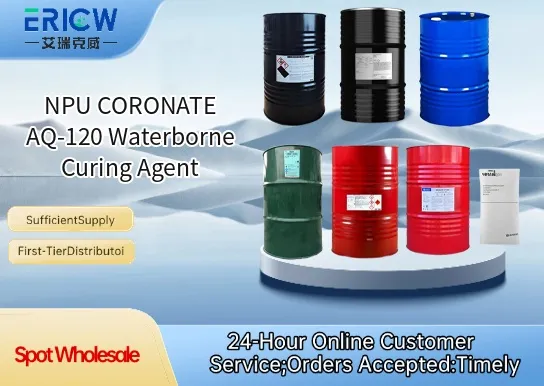
Low-VOC, water-dispersible aliphatic polyisocyanate curing agent compliant with global environmental regulations.
Excellent hydrolytic stability for extended pot life in aqueous two-component polyurethane systems.
Enables rapid ambient-cure film formation with high crosslink density and superior hardness development.
Provides outstanding chemical resistance, including to solvents, cleaners, and mild acids.
Compatible with a broad range of waterborne acrylic, polyester, and polyurethane dispersions.
Architectural and industrial waterborne topcoats for metal substrates.
High-performance wood coatings requiring low emissions and fast handling.
Automotive refinish clearcoats and basecoat/clearcoat systems.
Plastic coatings for interior automotive parts and consumer electronics housings.
Waterborne coil coatings for pre-finished building panels and appliances.
| Chemical Type | Aliphatic polyisocyanate (HDI-based trimer) |
| Product Form | Water-dispersible liquid |
| Appearance | Clear to slightly hazy, colorless to pale yellow dispersion |
| NCO Content (wt%) | 9.5 – 10.5% |
| pH (10% aqueous dispersion) | 7.0 – 8.5 |
| Viscosity (25°C, mPa·s) | 200 – 600 (Brookfield RVT, spindle #3, 20 rpm) |
| Solids Content (wt%) | 45 – 50% |
| Primary Applications | Two-component waterborne polyurethane coatings |
Q1: What types of waterborne resins is NPU CORONATE AQ-120 compatible with?
A: NPU CORONATE AQ-120 is specifically designed for use with aqueous polyurethane dispersions (PUDs), acrylic emulsions, and hybrid acrylic-PUD systems. It provides efficient crosslinking in neutral to mildly alkaline formulations and demonstrates good compatibility with common co-solvents and surfactants used in waterborne coatings.
Q2: How does AQ-120 affect pot life and film formation in waterborne coatings?
A: As a blocked aliphatic polyisocyanate, AQ-120 offers extended pot life at ambient temperatures—typically several hours depending on formulation pH, catalyst presence, and ambient humidity. Film formation proceeds via thermal activation, with full crosslinking generally achieved above 80 °C, supporting good hardness development and chemical resistance without premature gelation during storage or application.
Q3: Can AQ-120 be used in low-VOC or zero-VOC coating systems?
A: Yes—AQ-120 is supplied as a water-dispersible solid with negligible volatile organic content, making it suitable for formulating low-VOC and zero-VOC compliant waterborne coatings. Its performance remains robust even in formulations where co-solvent levels are minimized to meet stringent environmental specifications.
Q4: Is post-addition of catalysts required for optimal cure performance?
A: While AQ-120 can achieve full cure thermally without added catalysts, the inclusion of mild tertiary amine or metal-based catalysts may accelerate crosslinking onset and improve low-temperature cure response. Catalyst selection and dosage should be evaluated case-by-case to balance reactivity, storage stability, and final film properties.
Q5: What handling precautions should be observed during formulation?
A: As with all isocyanate-containing materials, avoid prolonged skin contact and inhalation of mists or dust. Use appropriate personal protective equipment (PPE), including nitrile gloves and eye protection. Store in tightly sealed containers under dry, cool conditions to prevent moisture-induced viscosity increase or gelation.
Contact With Us:
E-mail: wangxingqiang@ericwchem.com
Have a Questions? Call Us:
Add:
Building A1, Jiete Industrial Park, Huangpu District, Guangzhou City, Guangdong Province, China