English
 Español
 tiếng việt
 русский
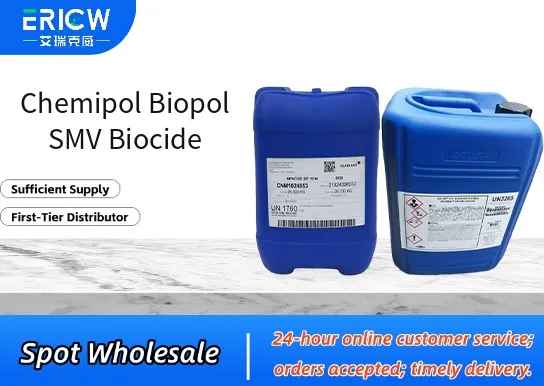
Effective broad-spectrum control against bacteria, fungi, and algae in water-based industrial systems.
Non-oxidizing biocide formulation compatible with common water treatment additives and polymers.
Stable performance across pH range 6.0–9.5 and temperatures up to 60 °C.
Low environmental impact with favorable aquatic toxicity profile (OECD 201/202 compliant).
Ready-to-use liquid concentrate requiring no on-site activation or dilution.
Cooling water systems in HVAC and industrial heat exchange circuits.
Process water loops in paper manufacturing and pulp mills.
Recirculating water in metalworking fluid sumps and machining operations.
Make-up water treatment for closed-loop industrial cooling towers.
Preservation of water-based emulsions and coatings during storage and transport.
| Chemical Type | Isothiazolinone-based non-oxidizing biocide |
| Product Form | Liquid concentrate |
| Appearance | Clear, pale yellow to amber solution |
| pH (1% aqueous solution) | 3.5–4.5 |
| Density (20 °C) | 1.08–1.12 g/cm³ |
| Solubility | Completely miscible in water |
| Primary Applications | Industrial water treatment, metalworking fluids, process water preservation |
| Key Features | Broad-spectrum efficacy, thermal & pH stability, low foam generation |
Q1: What is Chemipol Biopol SMV Biocide primarily used for?
A: Chemipol Biopol SMV Biocide is a broad-spectrum preservative designed for use in water-based polymer emulsions, adhesives, coatings, and other industrial formulations where microbial growth—especially bacteria and fungi—can compromise product stability, shelf life, or performance.
Q2: Is Chemipol Biopol SMV Biocide compatible with common anionic, nonionic, and cationic surfactants?
A: Yes, it demonstrates good compatibility across a wide range of surfactant types and is formulated to remain stable and effective in complex, multi-component systems typical of modern polymer dispersions and industrial coatings.
Q3: How should Chemipol Biopol SMV Biocide be added to a formulation?
A: It is typically added during the cool-down phase of manufacturing, after high-temperature processing is complete, to preserve biocidal activity. Dosage depends on formulation requirements but generally ranges from 0.1% to 2% by weight of the final product.
Q4: Does Chemipol Biopol SMV Biocide affect the viscosity or appearance of polymer emulsions?
A: When used at recommended levels, it typically has minimal impact on rheology, clarity, or film formation—making it suitable for both clear and pigmented systems without requiring reformulation adjustments.
Contact With Us:
E-mail: wangxingqiang@ericwchem.com
Have a Questions? Call Us:
Add:
Building A1, Jiete Industrial Park, Huangpu District, Guangzhou City, Guangdong Province, China